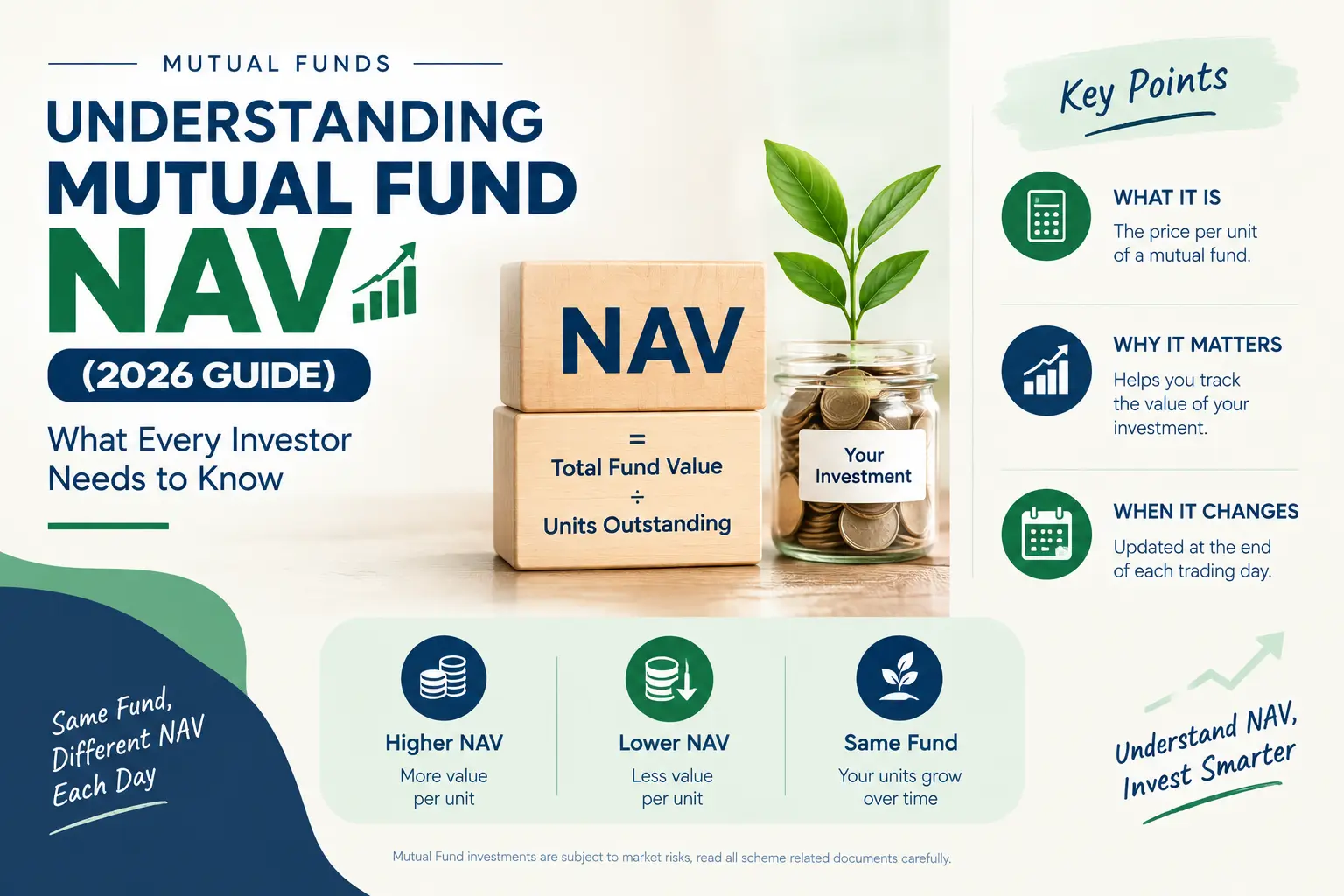
Understanding Mutual Fund NAV (2026 Guide): What Every Investor Needs to Know
Understanding Mutual Fund NAV (2026 Guide): What Every Investor Needs to Know
Why a Higher NAV Doesn't Mean a Better Mutual Fund
One of the most common misconceptions among new mutual fund investors is that a fund with a lower Net Asset Value (NAV) is cheaper or offers better returns than a fund with a higher NAV.
In reality, NAV is simply the price of one mutual fund unit—it does not indicate whether a fund is good or bad.
Understanding how NAV works can help you make better investment decisions and avoid one of the biggest myths in mutual fund investing.
Let's simplify everything you need to know about Mutual Fund NAV.
What is NAV in Mutual Funds?
Net Asset Value (NAV) is the per-unit value of a mutual fund.
It represents the market value of all the securities held by the fund after deducting its liabilities and expenses, divided by the total number of outstanding units.
In simple words:
NAV tells you how much one unit of a mutual fund is worth on a particular day.
Unlike stock prices, which fluctuate throughout market hours, mutual fund NAV is calculated once every business day after the stock market closes.
How is NAV Calculated?
The formula for NAV is:
NAV = (Total Assets – Total Liabilities) ÷ Total Outstanding Units
Where:
- Total Assets include stocks, bonds, cash, and other investments held by the fund.
- Liabilities include expenses, management fees, and operational costs.
- Outstanding Units represent the total number of units held by all investors.
Example of NAV Calculation
Suppose a mutual fund has:
- Total Assets = ₹500 crore
- Total Liabilities = ₹20 crore
- Outstanding Units = 48 crore
Then,
NAV = (₹500 crore – ₹20 crore) ÷ 48 crore = ₹10 per unit
If you invest ₹10,000, you'll receive approximately 1,000 units (excluding applicable charges, if any).
Does a High NAV Mean a Better Mutual Fund?
No.
This is one of the biggest myths in mutual fund investing.
Many investors assume:
- Low NAV = Cheap fund
- High NAV = Expensive fund
Neither assumption is correct.
Example
| Fund | NAV | Annual Return |
|---|---|---|
| Fund A | ₹20 | 15% |
| Fund B | ₹100 | 15% |
Both funds generated the same percentage return, despite having different NAVs.
Your investment grows based on percentage returns, not the NAV itself.
Why NAV Alone Should Not Influence Your Investment Decision
Choosing a mutual fund based solely on NAV is similar to buying a company simply because its share price is low.
Instead, investors should evaluate:
- Investment objective
- Fund manager's experience
- Portfolio quality
- Risk-adjusted performance
- Expense ratio
- Consistency across market cycles
- Suitability for financial goals
How NAV Affects Your Mutual Fund Investment
When You Buy Mutual Fund Units
Your investment amount is divided by the applicable NAV.
For example:
Investment Amount = ₹20,000
NAV = ₹50
Units Allotted = 400 units
When You Redeem Mutual Fund Units
Your redemption amount depends on the NAV applicable on the day your redemption request is processed, subject to SEBI's applicable cut-off timing rules.
If NAV has increased since your purchase, your investment value may increase. If NAV has declined, the redemption value may be lower.
Types of NAV
1. Daily NAV
Most open-ended mutual funds publish their NAV once every business day after market hours.
This is the official NAV used for purchase and redemption transactions.
2. Indicative NAV (iNAV)
Exchange Traded Funds (ETFs) may display an Indicative NAV (iNAV) during trading hours.
It provides an estimate of the fund's real-time value but is not the official end-of-day NAV.
What Causes NAV to Change?
NAV changes because the value of the underlying investments changes.
Major factors include:
Market Movements
If the stocks or bonds held by the mutual fund rise or fall in value, the NAV changes accordingly.
Interest Rate Changes
Debt mutual funds are influenced by changes in interest rates, which affect bond prices and, consequently, NAV.
Dividend or Income Distribution
If a scheme declares an income distribution (where applicable), the NAV generally adjusts by the amount distributed.
Fund Expenses
Expense ratios and operating costs are deducted from the fund's assets over time, affecting NAV.
Portfolio Changes
Buying and selling securities within the portfolio may also influence the fund's overall value.
Where Can You Check Mutual Fund NAV?
You can check the latest NAV through:
- The Association of Mutual Funds in India (AMFI) website
- The Asset Management Company's (AMC) official website
- Registrar platforms such as CAMS and KFin Technologies
- Mutual fund investment apps and brokerage platforms
NAVs are updated every business day after market closure.
Common Myths About NAV
Myth 1: Lower NAV Means Better Returns
Reality: Returns depend on portfolio performance—not NAV.
Myth 2: Higher NAV Means the Fund is Expensive
Reality: A higher NAV simply indicates that the fund's value has grown over time.
Myth 3: New Fund Offers (NFOs) Are Better Because NAV Starts at ₹10
Reality: An NFO launching at ₹10 is not inherently cheaper than an existing fund with a NAV of ₹150. What matters is the quality of the portfolio, investment strategy, and long-term performance—not the starting NAV.
What Should Investors Focus on Instead of NAV?
Instead of comparing NAVs, evaluate:
- Your financial goals
- Investment horizon
- Risk appetite
- Asset allocation
- Fund category
- Consistency of returns
- Expense ratio
- Fund manager's track record
A well-chosen mutual fund aligned with your goals is far more important than its NAV.
Conclusion
Net Asset Value (NAV) is an important concept in mutual fund investing because it determines the price at which units are bought and redeemed.
However, NAV is not a measure of a mutual fund's quality or future return potential.
Successful investing depends on selecting funds that match your financial goals, understanding your risk tolerance, and staying invested for the long term—not on choosing funds with the lowest NAV.
Before investing, focus on the fund's overall strategy, historical consistency, and suitability for your investment objectives rather than the NAV alone.
Frequently Asked Questions (FAQs)
1. Is a mutual fund with a lower NAV better than one with a higher NAV?
No. NAV only represents the per-unit value of the mutual fund. A lower NAV does not make a fund cheaper or more attractive. Returns depend on the performance of the underlying portfolio.
2. When is NAV updated?
For most open-ended mutual funds, NAV is calculated and published once every business day after the market closes. The applicable NAV for your transaction depends on SEBI's cut-off timing rules and when your investment or redemption request is processed.
3. Does NAV affect my returns?
NAV determines the price at which you buy or redeem mutual fund units. However, your overall returns depend on how the fund's underlying investments perform over time, not on whether the NAV is high or low.