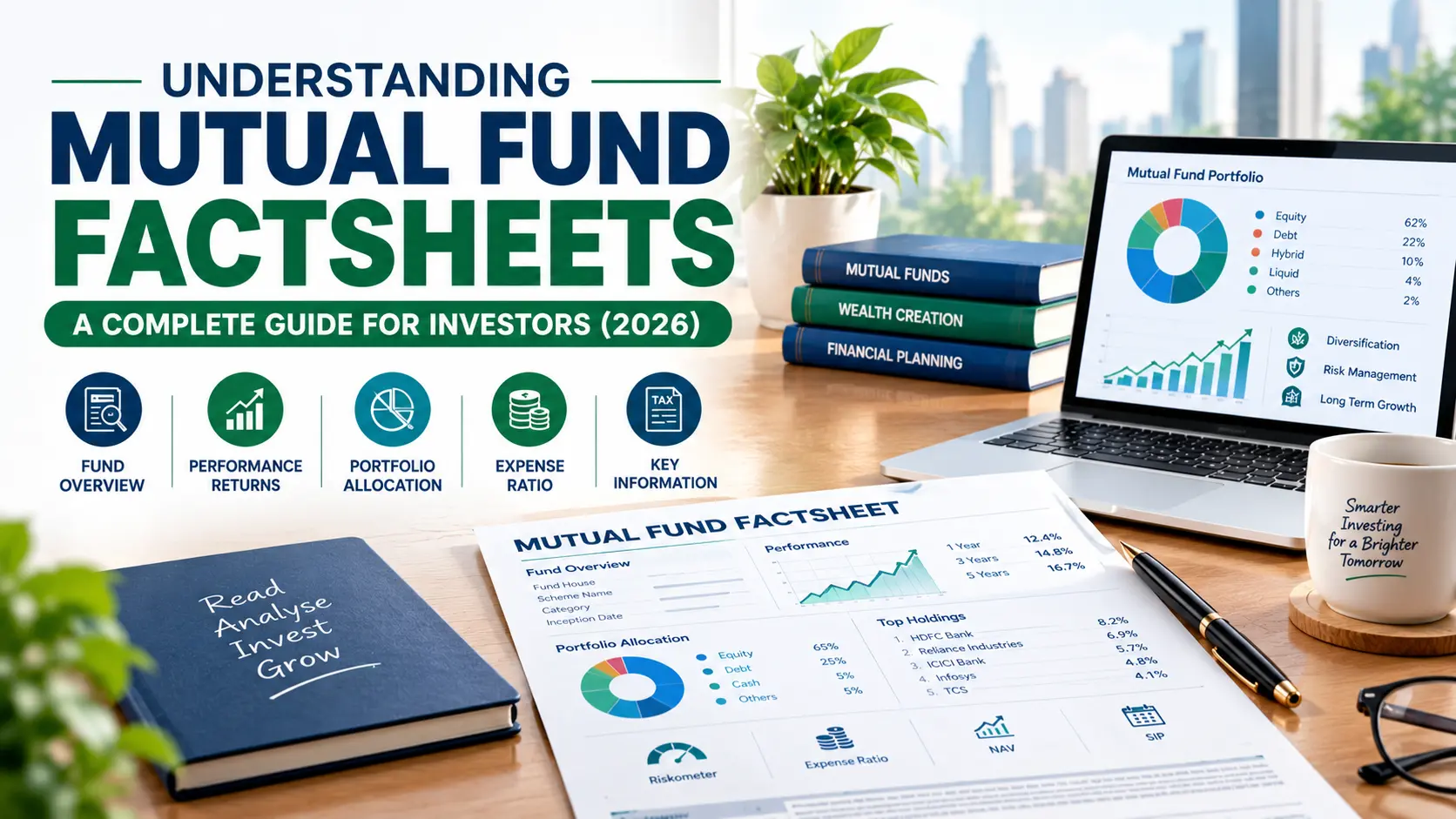
Understanding Mutual Fund Factsheets: A Complete Guide for Investors (2026)
Understanding Mutual Fund Factsheets: A Complete Guide for Investors (2026)
Mutual fund factsheets are one of the most valuable resources available to investors. Whether you're investing through SIPs or making a lump sum investment, understanding a fund's factsheet can help you evaluate its performance, risk level, portfolio quality and overall suitability for your financial aims.
Many investors focus only on past returns while choosing a mutual fund, but a factsheet contains much more valuable information. It offers insights into the fund manager's strategy, portfolio allocation, expenses, risk metrics and investment philosophy.
In this guide, we'll explain every important section of a mutual fund factsheet in simple terms so you can make more informed investment decisions.
What is a Mutual Fund Factsheet?
A mutual fund factsheet is a monthly document published by Asset Management Companies (AMCs) that provides detailed information about a mutual fund scheme.
It acts as a report card, helping investors understand:
- Fund performance
- Portfolio holdings
- Risk level
- Asset allocation
- Expense ratio
- Fund manager details
- Investment strategy
- Key financial ratios
Reviewing a factsheet regularly allows investors to monitor their investments and ensure they continue to align with their financial aims.
Why Should Investors Read a Mutual Fund Factsheet?
A factsheet helps investors go beyond marketing material and understand how a fund is actually performing.
It enables you to:
- Compare different mutual funds.
- Evaluate risk and return.
- Understand where your money is invested.
- Monitor changes in portfolio allocation.
- Assess fund management quality.
- Make informed investment decisions.
Reading a factsheet before investing can help you avoid choosing funds based solely on recent returns.
Key Sections of a Mutual Fund Factsheet
1. Fund Overview
The first section provides basic information about the mutual fund.
It generally includes:
- Scheme name
- Fund category
- Asset Management Company (AMC)
- Fund mandate
- Benchmark index
- Inception date
- Assets Under Management (AUM)
This section helps investors understand the purpose of the fund and the type of assets it invests in.
Fund mandate
Every mutual fund is created with a specific objective.
For example:
- Long-term wealth creation
- Regular income generation
- Capital preservation
- Tax savings
- Balanced growth
Ensure that the Fund mandate matches your own financial aims before investing.
Fund Performance
Performance is one of the most closely watched sections of a factsheet.
It generally shows returns over different time periods such as:
- 1 Month
- 3 Months
- 6 Months
- 1 Year
- 3 Years
- 5 Years
- Since Inception
Returns are usually compared against the fund's benchmark and category average.
While historical performance is useful, remember that past performance does not guarantee future returns.
Instead of focusing only on short term returns, evaluate consistency across different market cycles.
Portfolio Holdings
This section shows where the fund has invested your money.
For equity funds, it includes:
- Top stock holdings
- Sector allocation
- Market capitalization allocation
- Cash holdings
For debt funds, it includes:
- Government securities
- Corporate bonds
- Treasury bills
- Commercial papers
- Credit ratings
- Average maturity
Understanding the portfolio helps you evaluate diversification and concentration risk.
Asset Allocation
Asset allocation indicates how the fund distributes investments across different asset classes.
Depending on the scheme, it may include:
- Equity
- Debt
- Cash
- Gold
- REITs and InvITs
- International securities
A diversified allocation generally helps reduce investment risk.
Risk Measures
Mutual fund factsheets include several statistical measures that help investors understand risk.
Some important metrics include:
Standard Deviation
Measures the volatility of the fund's returns.
Higher standard deviation generally indicates greater fluctuations.
Beta
Shows how sensitive the fund is compared to the overall market.
- Beta greater than 1 indicates higher volatility than the market.
- Beta less than 1 indicates relatively lower volatility.
Sharpe Ratio
Measures risk adjusted returns.
A higher Sharpe Ratio generally indicates that the fund has delivered better returns for the level of risk taken.
Alpha
Alpha measures the fund manager's ability to generate returns above the benchmark.
A positive alpha suggests the fund has outperformed its benchmark after adjusting for risk.
Expense Ratio
The expense ratio represents the annual cost of managing the mutual fund.
It includes:
- Fund management fees
- Administrative expenses
- Operational costs
A lower expense ratio allows investors to retain more of their investment returns.
When comparing similar mutual funds, always consider the expense ratio along with performance and consistency.
Assets Under Management (AUM)
AUM represents the total market value of assets managed by the mutual fund.
A larger AUM may indicate investor confidence, but it does not necessarily mean the fund will perform better.
Both large and small funds can perform well depending on their investment strategy and management.
Fund Manager Details
Most factsheets provide information about the fund manager, including:
- Name
- Experience
- Educational background
- Other schemes managed
An experienced fund manager with a consistent investment approach can add significant value over the long term.
Sector Allocation
For equity funds, the factsheet shows how investments are distributed across industries.
Common sectors include:
- Banking and Financial Services
- Information Technology
- Healthcare
- FMCG
- Automobile
- Infrastructure
- Energy
- Pharmaceuticals
Sector allocation helps investors understand whether the portfolio is well diversified or heavily concentrated in specific industries.
Market Capitalization Allocation
Equity funds may also classify investments based on company size:
- Large Cap
- Mid Cap
- Small Cap
Each category offers a different balance between growth potential and risk.
Understanding this allocation helps investors assess whether the fund matches their risk appetite.
Exit Load and Minimum Investment
Factsheets also mention operational details such as:
- Minimum lump sum investment
- Minimum SIP amount
- Exit load
- Lock in period (if applicable)
Investors should review these details before investing to avoid unexpected costs.
Fund Manager's Commentary
Many AMCs include a monthly commentary from the fund manager explaining:
- Market outlook
- Investment strategy
- Recent portfolio changes
- Economic developments
- Sector views
This section helps investors understand why certain investment decisions were made and how the fund is positioned for future opportunities.
Things to Look for Before Investing
Before investing in any mutual fund, consider the following:
- Does the fund mandate match your financial aims?
- Has the fund delivered consistent long term performance?
- Is the portfolio well diversified?
- Are the risk levels suitable for you?
- Is the expense ratio reasonable?
- Does the fund manager have a strong track record?
- How does the fund compare with its benchmark and category peers?
Looking at these factors together provides a much clearer picture than focusing on returns alone.
Common Mistakes Investors Make
Many investors overlook important details in a factsheet.
Some common mistakes include:
- Choosing funds solely based on recent returns.
- Ignoring risk measures.
- Not checking the expense ratio.
- Overlooking portfolio concentration.
- Ignoring changes in fund strategy.
- Failing to review factsheets regularly.
Avoiding these mistakes can lead to better investment decisions over the long term.
Conclusion
A mutual fund factsheet is much more than a performance report it's a comprehensive document that provides valuable insights into a fund's investment strategy, portfolio, risk profile and overall management.
By learning how to read and interpret factsheets, investors can make more informed decisions, compare mutual funds effectively and build portfolios that align with their financial aims and risk tolerance.
Whether you are a beginner or an experienced investor, reviewing your mutual fund factsheets regularly is an essential habit for successful long term investing.
Frequently Asked Questions (FAQs)
1. How often are mutual fund factsheets updated?
Most Asset Management Companies (AMCs) publish mutual fund factsheets every month, providing updated information on portfolio holdings, performance, risk metrics and fund allocation.
2. What is the most important section of a mutual fund factsheet?
While every section is useful, investors should pay particular attention to the Fund mandate, historical performance, portfolio composition, risk measures, expense ratio and fund manager's commentary before making investment decisions.
3. Does a higher AUM mean a better mutual fund?
Not necessarily. A larger Assets Under Management (AUM) may indicate investor confidence, but fund performance depends on factors such as portfolio quality, investment strategy, market conditions and fund management rather than size alone.
4. Why is the expense ratio important?
The expense ratio represents the annual cost of managing the fund. Lower expenses generally allow investors to retain a larger share of their investment returns over the long term, making it an important factor when comparing similar mutual funds.
5. Should I rely only on past performance while selecting a mutual fund?
No. Past performance should never be the sole criterion for selecting a mutual fund. Investors should also evaluate risk, portfolio quality, diversification, consistency, expense ratio, investment philosophy and whether the fund aligns with their financial aims and investment horizon.