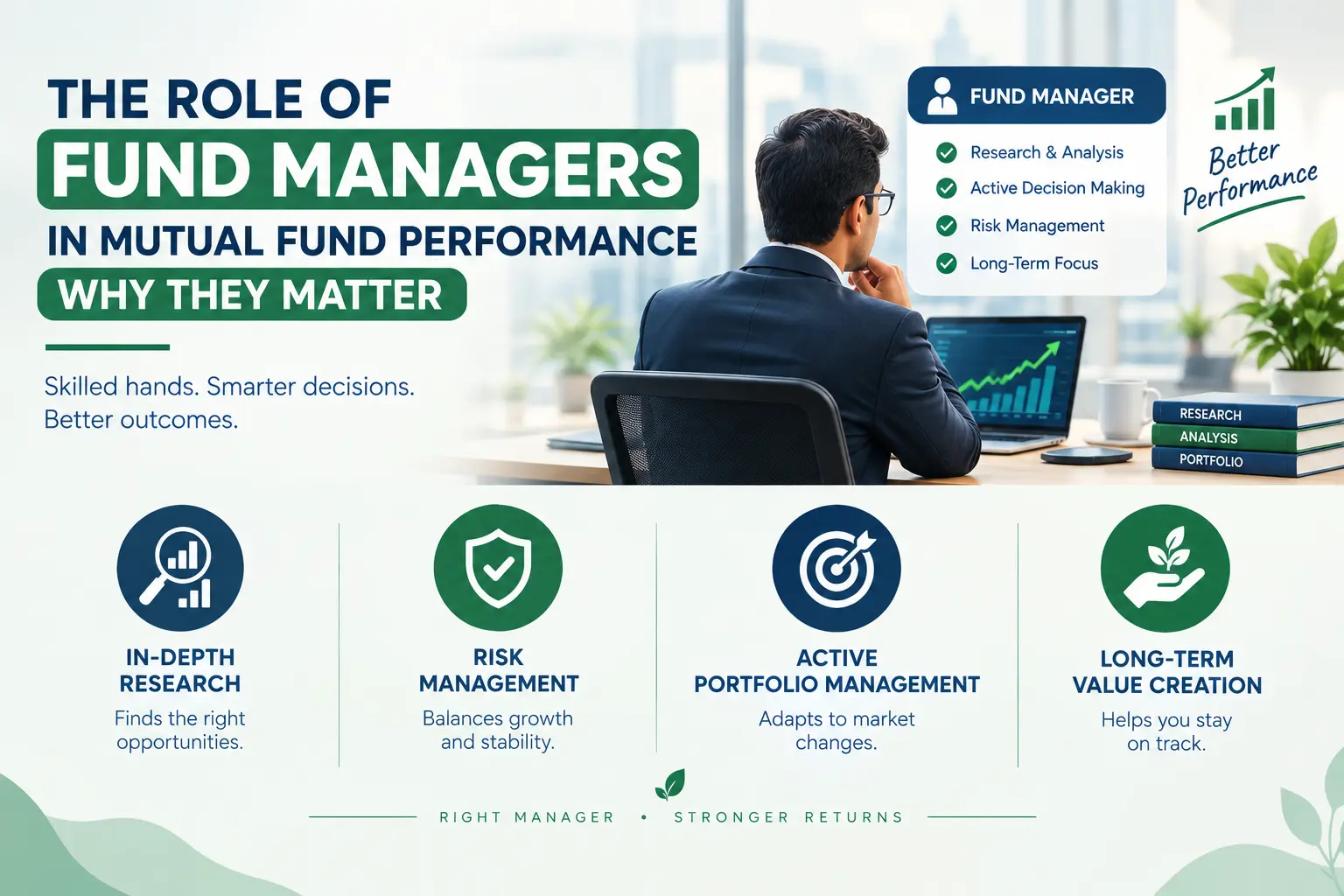
The Role of Fund Managers in Mutual Fund Performance: Why They Matter
The Role of Fund Managers in Mutual Fund Performance: Why They Matter
When investing in mutual funds, many investors focus primarily on past returns. However, one of the most important factors behind a mutual fund's long-term performance is the fund manager and the investment team responsible for managing the portfolio.
A fund manager doesn't simply buy and sell securities. They make strategic decisions based on research, market conditions, risk management principles, and the fund's investment objective.
While no fund manager can consistently outperform the market or guarantee returns, their expertise can significantly influence how a mutual fund performs across different market cycles.
Let's understand why fund managers play such an important role in mutual fund investing.
Who Is a Fund Manager?
A fund manager is a qualified investment professional responsible for managing a mutual fund's portfolio on behalf of investors.
Their responsibilities include:
- Researching investment opportunities.
- Selecting securities.
- Monitoring portfolio performance.
- Managing risk.
- Ensuring the fund remains aligned with its stated investment objective.
Fund managers are supported by teams of research analysts, economists, risk specialists, and portfolio managers who collectively help make investment decisions.
Why Fund Managers Matter
Every mutual fund follows a defined investment mandate.
The fund manager's responsibility is to execute that mandate while seeking to generate returns appropriate for the level of risk the scheme is designed to take.
Good fund management is about balancing three important objectives:
- Capital growth.
- Risk management.
- Portfolio consistency.
Key Responsibilities of a Fund Manager
1. Developing an Investment Strategy
Every mutual fund has a specific investment objective.
For example:
- Large-cap equity funds invest primarily in established companies.
- Mid-cap funds focus on medium-sized businesses.
- Debt funds invest in fixed-income securities.
- Hybrid funds combine equity and debt investments.
The fund manager ensures the portfolio remains aligned with the scheme's mandate while adapting to changing market conditions.
2. Conducting In-Depth Research
Investment decisions are backed by extensive research rather than speculation.
Fund managers continuously evaluate:
- Company financial statements.
- Industry trends.
- Economic indicators.
- Interest rate movements.
- Corporate governance.
- Business fundamentals.
This research helps identify investment opportunities while avoiding unnecessary risks.
3. Managing Risk
One of the most important responsibilities of a fund manager is managing risk—not simply maximizing returns.
Risk management may include:
- Diversification across sectors.
- Appropriate asset allocation.
- Position sizing.
- Liquidity management.
- Monitoring portfolio concentration.
Protecting capital during market downturns is often as important as generating returns during bull markets.
4. Portfolio Rebalancing
Markets constantly evolve.
As stock prices, interest rates, and economic conditions change, portfolios require periodic adjustments.
Fund managers regularly rebalance portfolios by:
- Increasing exposure to attractive opportunities.
- Reducing positions where valuations become excessive.
- Managing sector allocations.
- Maintaining alignment with the fund's investment objective.
5. Monitoring Performance
Fund managers continuously compare the fund's performance against:
- Benchmark indices.
- Peer funds.
- Risk-adjusted return metrics.
- Portfolio objectives.
Performance monitoring is an ongoing process rather than an annual exercise.
How Fund Managers Influence Mutual Fund Performance
Although markets ultimately determine investment returns, fund managers influence outcomes through disciplined decision-making.
Some of the areas where their expertise matters include:
Stock Selection
Selecting fundamentally strong businesses with long-term growth potential can contribute to portfolio performance.
Asset Allocation
Balancing investments across different asset classes helps manage risk while pursuing investment objectives.
Portfolio Diversification
A diversified portfolio reduces dependence on any single company or sector.
Responding to Market Conditions
Experienced fund managers continuously evaluate changing economic conditions and adjust portfolios when necessary, while remaining consistent with the fund's long-term strategy.
Active Funds vs Passive Funds
Not all mutual funds rely on fund managers in the same way.
Active Mutual Funds
In actively managed funds, fund managers actively select investments with the objective of outperforming a benchmark index.
Performance depends significantly on the quality of research, investment decisions, and portfolio management.
Passive Mutual Funds
Index funds and Exchange Traded Funds (ETFs) seek to replicate the performance of a market index such as the Nifty 50 or Sensex.
The fund manager's role is primarily to ensure that the portfolio closely tracks the benchmark while minimizing tracking error.
This distinction is important because the influence of a fund manager is generally greater in actively managed funds than in passive investment strategies.
How to Evaluate a Fund Manager
While investors should not choose a mutual fund solely based on the fund manager, evaluating the investment team is an important part of fund selection.
Consider factors such as:
Experience
Has the manager successfully navigated multiple market cycles?
Long-term experience can provide valuable perspective during volatile markets.
Consistency
Instead of focusing only on short-term returns, evaluate how consistently the fund has performed over different time periods.
Investment Philosophy
Does the fund manager follow a disciplined and clearly defined investment approach?
Consistency in investment philosophy is often more important than occasional periods of exceptional performance.
Portfolio Stability
Frequent changes in portfolio strategy may increase uncertainty.
A stable investment process generally reflects disciplined portfolio management.
What Investors Should Remember
A highly experienced fund manager does not guarantee superior returns.
Mutual fund performance also depends on factors such as:
- Market conditions.
- Economic cycles.
- Interest rates.
- Fund category.
- Investment mandate.
- Expense ratio.
- Overall asset allocation.
Investors should evaluate the entire mutual fund—not just the individual managing it.
Final Thoughts
Fund managers play a crucial role in translating a mutual fund's investment objective into a well-managed portfolio. Through research, disciplined investing, risk management, and portfolio monitoring, they help investors participate in financial markets without having to manage investments themselves.
However, successful investing should never rely solely on the reputation of a fund manager. Investors should also consider the fund's objective, consistency, risk profile, expense ratio, and suitability for their own financial goals.
At Moneytree Partners, we believe successful investing begins with selecting the right investment strategy—not simply chasing the best-performing fund or the most well-known fund manager. A goal-based, diversified approach remains the foundation of long-term wealth creation.
Mutual Fund investments are subject to market risks. Please read all scheme-related documents carefully before investing. Past performance does not guarantee future returns.
Frequently Asked Questions (FAQs)
1. Does a good fund manager guarantee higher returns?
No. A skilled fund manager can improve the quality of investment decisions and risk management, but mutual fund returns also depend on market conditions, economic factors, and the fund's investment mandate. No fund manager can guarantee future performance.
2. Are fund managers important for index funds?
Yes, but their role differs from actively managed funds. In index funds, the objective is to closely replicate the benchmark index by minimizing tracking error rather than selecting stocks to outperform the market.
3. How can investors evaluate a fund manager?
Investors should consider the fund manager's experience, investment philosophy, consistency across market cycles, and long-term performance while also evaluating the fund's objective, expense ratio, risk profile, and overall suitability for their financial goals.
4. Should I choose a mutual fund based only on the fund manager?
No. While the fund manager is an important factor, investors should also assess the fund's investment objective, historical consistency, portfolio composition, costs, risk-adjusted performance, and alignment with their own financial goals.
5. What happens if a fund manager changes?
Fund houses generally have structured investment processes supported by research teams, so a change in fund manager does not automatically affect a fund's performance. However, investors should monitor whether the new manager maintains a similar investment philosophy and whether the fund continues to meet its stated objectives.