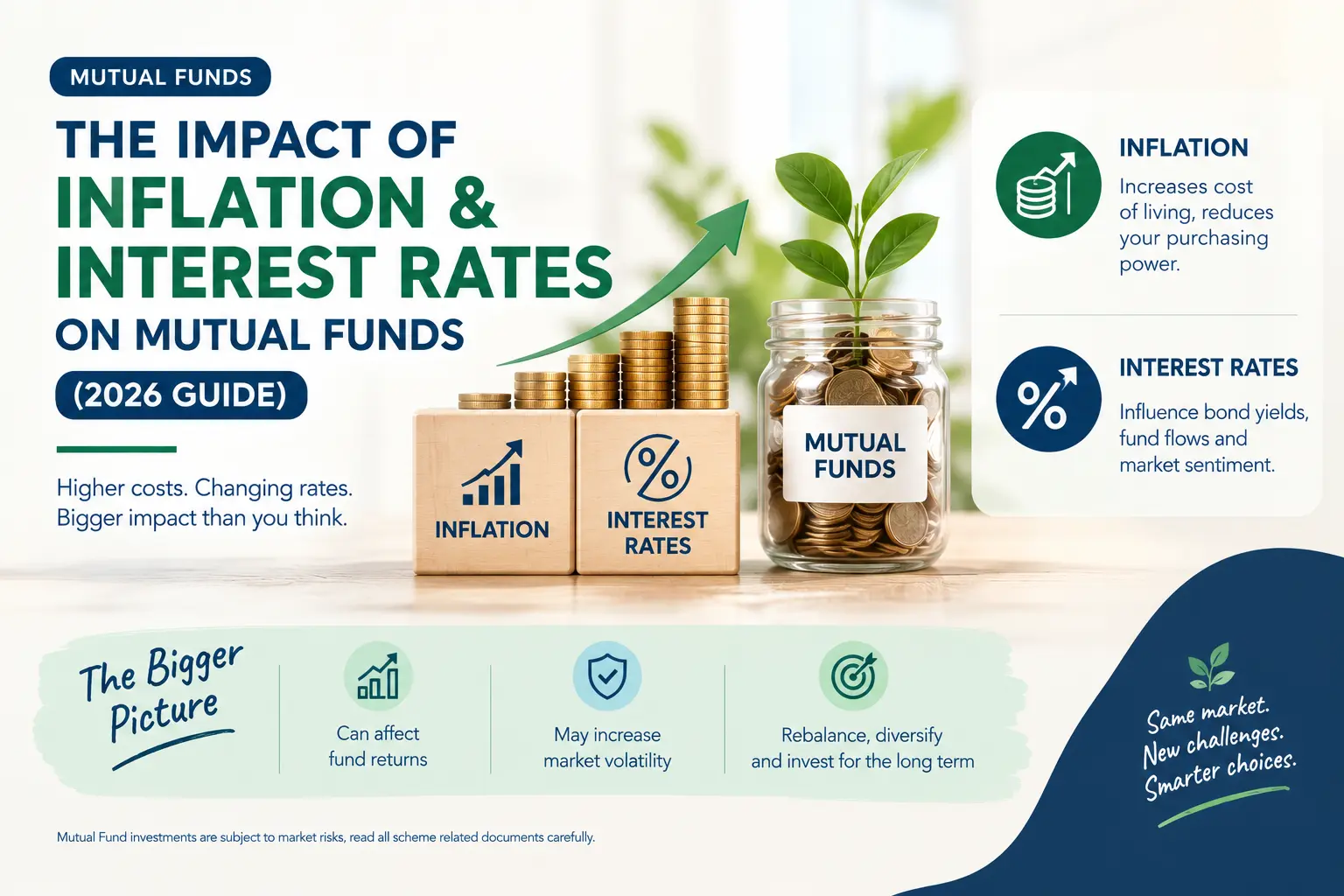
The Impact of Inflation and Interest Rates on Mutual Funds (2026 Guide)
The Impact of Inflation and Interest Rates on Mutual Funds (2026 Guide)
Inflation and interest rates are two of the most important economic factors that influence investment returns. Whether you invest through SIPs or lump sum investments, understanding how these factors affect different types of mutual funds can help you make better investment decisions.
With inflation moderating and the Reserve Bank of India (RBI) continuously balancing economic growth and price stability, investors often wonder:
- Should I continue my SIP during inflation?
- Which mutual funds perform better when interest rates rise?
- Are debt funds still worth investing in?
- How should I position my portfolio during different market cycles?
Let's understand everything in simple language.
What is Inflation?
Inflation refers to the increase in the prices of goods and services over time. As prices rise, the purchasing power of your money falls.
For example:
If groceries cost ₹10,000 today and inflation averages 6% annually, the same groceries may cost around ₹10,600 next year.
Simply put, your money buys fewer goods and services over time.
In India, inflation is primarily measured through the Consumer Price Index (CPI) and is closely monitored by the Reserve Bank of India (RBI) while making monetary policy decisions.
What Are Interest Rates?
Interest rates represent the cost of borrowing money.
The RBI influences borrowing costs through the Repo Rate, which is the rate at which commercial banks borrow funds from the RBI.
When inflation rises significantly, the RBI may increase interest rates to control demand and stabilize prices. Conversely, when economic growth slows, the RBI may reduce interest rates to encourage borrowing and investment.
These changes directly impact:
- Home loans
- Personal loans
- Fixed deposits
- Bond yields
- Stock markets
- Mutual funds
Why Should Mutual Fund Investors Care?
Inflation and interest rates affect almost every asset class.
Different mutual funds react differently depending on market conditions.
| Fund Type | Impact of High Inflation | Impact of Rising Interest Rates |
|---|---|---|
| Equity Funds | Mixed | Moderate |
| Debt Funds | Negative (especially long-duration) | High impact |
| Hybrid Funds | Moderate | Balanced |
| Liquid Funds | Minimal | Usually benefit gradually |
Understanding these relationships helps investors avoid panic during market volatility.
How Inflation Affects Equity Mutual Funds
Equity mutual funds invest primarily in company shares.
When inflation rises:
- Raw material costs increase.
- Employee expenses rise.
- Borrowing becomes expensive.
- Corporate profit margins may shrink.
As a result, stock prices may become volatile.
However, not every sector reacts the same way.
Sectors That May Perform Better During Inflation
Certain industries often manage inflation more effectively because they can pass higher costs on to customers.
These include:
- FMCG
- Healthcare
- Utilities
- Energy
- Select Banking stocks
Well-diversified equity mutual funds can therefore provide some protection against inflation over the long term.
How Inflation Affects Debt Mutual Funds
Debt mutual funds are generally more sensitive to inflation.
When inflation rises:
- RBI may increase interest rates.
- New bonds offer higher yields.
- Existing bonds with lower yields become less attractive.
- Prices of existing bonds fall.
Since debt mutual funds invest in bonds, their Net Asset Value (NAV) may decline during rising interest-rate cycles.
Long-duration debt funds are usually affected more than short-duration funds.
Why Duration Matters
One important concept many investors overlook is duration.
Duration measures how sensitive a bond or debt fund is to changes in interest rates.
Generally:
- Long-duration funds experience larger price fluctuations.
- Short-duration funds remain relatively stable.
- Liquid funds are least affected.
If interest rates are expected to remain high or increase further, many investors prefer shorter-duration debt funds.
How Interest Rates Affect Equity Mutual Funds
Interest rates also influence the stock market.
When rates rise:
- Companies pay more interest on loans.
- Expansion plans may slow.
- Consumer spending may reduce.
- Corporate earnings may come under pressure.
This can temporarily affect stock prices.
However, rising interest rates don't necessarily mean equity markets will perform poorly.
If rate hikes are accompanied by strong economic growth and healthy corporate earnings, markets can continue performing well over the long term.
Which Sectors Benefit From Higher Interest Rates?
Some sectors may actually benefit.
These include:
- Banks
- Insurance companies
- Financial services
Higher lending rates often improve profit margins for financial institutions.
Mutual funds with higher exposure to these sectors may perform relatively better during rising-rate environments.
How Interest Rates Affect Debt Mutual Funds
Debt funds are directly linked to bond markets.
When Interest Rates Rise
- Existing bond prices decline.
- Long-term debt funds may generate lower short-term returns.
- NAV may temporarily fall.
When Interest Rates Fall
- Existing bonds become more valuable.
- Bond prices rise.
- Debt funds often generate capital gains.
This explains why debt fund performance varies across different interest-rate cycles.
How Hybrid Mutual Funds Respond
Hybrid funds invest in both:
- Equity
- Debt
Because of this diversification, they generally experience less volatility compared to pure equity or debt funds.
Balanced Advantage Funds and Dynamic Asset Allocation Funds can automatically adjust equity and debt exposure depending on market conditions, making them suitable for investors seeking moderate risk.
Should You Stop Your SIP During Inflation?
One of the biggest mistakes investors make is stopping SIPs during uncertain markets.
In reality, inflation-driven volatility can actually benefit long-term SIP investors.
When markets fall:
- SIP purchases more units.
When markets recover:
- Those additional units appreciate.
This process is called Rupee Cost Averaging.
Historically, disciplined SIP investing through different market cycles has helped investors build wealth over the long term.
Investment Strategies During Inflation
Here are some practical strategies investors can consider.
1. Continue SIPs
Avoid trying to time the market.
Consistency usually works better than attempting to predict market movements.
2. Diversify Your Portfolio
A balanced portfolio may include:
- Large-cap equity funds
- Flexi-cap funds
- Hybrid funds
- Short-duration debt funds
- International exposure (where appropriate)
Diversification helps reduce concentration risk.
3. Match Investments With Goals
Different financial goals require different investment strategies.
| Goal | Suggested Fund Type |
|---|---|
| Emergency Fund | Liquid Funds |
| 2–3 Years | Short Duration Debt Funds |
| 5+ Years | Equity Mutual Funds |
| Retirement | Flexi Cap + Hybrid Funds |
| Wealth Creation | Equity SIPs |
4. Focus on Asset Allocation
Asset allocation often has a greater impact on long-term returns than selecting the "best" mutual fund.
Review your allocation periodically and rebalance when necessary.
5. Don't Chase Recent Performance
Funds that performed exceptionally well last year may not remain top performers.
Instead, evaluate:
- Investment philosophy
- Consistency
- Fund manager experience
- Risk-adjusted performance
- Expense ratio
- Portfolio quality
Common Mistakes Investors Should Avoid
- Stopping SIPs during market corrections.
- Redeeming investments after temporary losses.
- Investing only based on recent returns.
- Ignoring asset allocation.
- Holding too many similar mutual funds.
- Investing without clear financial goals.
What Should Investors Watch?
While no one can accurately predict markets, investors should monitor:
- RBI Monetary Policy announcements
- Inflation (CPI) trends
- GDP growth
- Corporate earnings
- Global interest-rate movements
- Geopolitical developments
These factors influence both equity and debt mutual fund performance.
Conclusion
Inflation and interest rates are inevitable parts of every economic cycle. While they can create short-term market volatility, they also present opportunities for disciplined investors.
Instead of reacting emotionally to every RBI policy announcement or market correction, investors should focus on long-term goals, maintain diversification, and continue investing consistently.
A well-constructed mutual fund portfolio—aligned with your financial objectives and risk appetite—can help you navigate different market environments while steadily building long-term wealth.
If you're unsure how changing interest rates or inflation may affect your investments, consult a qualified financial advisor who can help you create a portfolio suited to your goals.
Frequently Asked Questions (FAQs)
1. Does high inflation always reduce mutual fund returns?
Not necessarily. Inflation may create short-term volatility, but well-managed equity mutual funds have historically outpaced inflation over long investment horizons. Debt funds, however, can be more sensitive to rising inflation and interest rates.
2. Which mutual funds perform better when interest rates are rising?
Short-duration debt funds, liquid funds, banking and financial sector funds, and well-diversified equity funds may be relatively better positioned during rising interest-rate cycles. The right choice depends on your investment objective and risk profile.
3. Should I stop my SIP when inflation is high?
Generally, no. Continuing your SIP during volatile markets allows you to benefit from rupee cost averaging, which can improve long-term returns as markets recover.
4. How often should I review my mutual fund portfolio?
Review your portfolio at least once or twice a year, or whenever there are significant changes in your financial goals, asset allocation, or market conditions. Avoid making frequent changes based solely on short-term market movements.