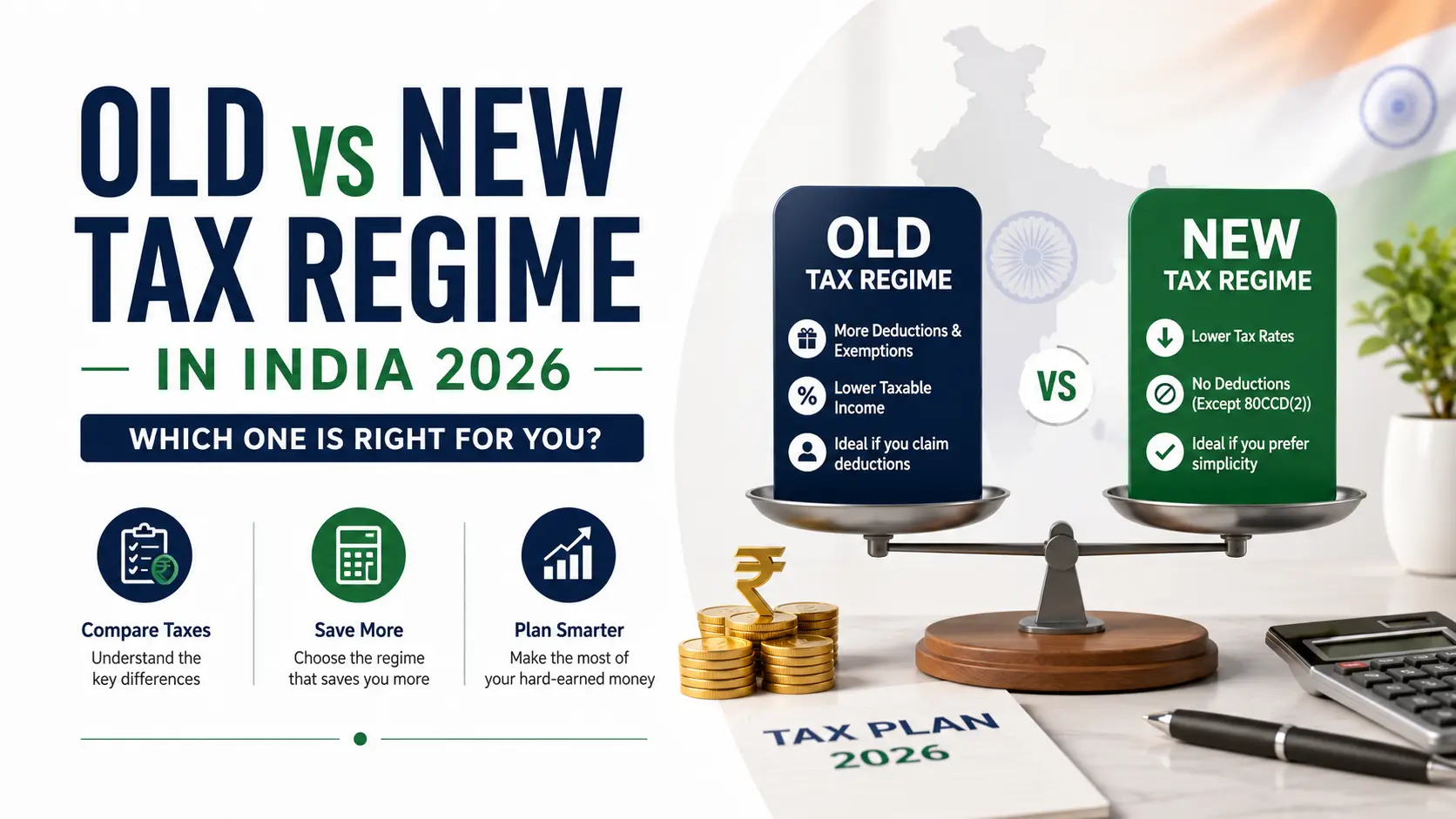
Old vs New Tax Regime in India 2026
Old vs New Tax Regime in India (2026): Which Tax Regime Should You Choose?
Choosing between the old and new tax regimes has become one of the most important tax decisions for Indian taxpayers.
The new tax regime offers lower tax rates and a simplified structure, while the old tax regime allows taxpayers to claim various deductions and exemptions. As a result, the better option is not the same for everyone.
Your ideal tax regime may depend on factors such as:
Annual income
Salary structure
Home loan interest
House Rent Allowance (HRA)
Investments under Section 80C
Health insurance premiums
National Pension System (NPS) contributions
Other eligible deductions and exemptions
A proper comparison can help you avoid paying more tax than necessary while making informed investment decisions.
In this guide, we will explain the difference between the old and new tax regimes, the latest considerations for 2026 and how taxpayers can evaluate which option may be more suitable for their financial situation.
What Is the Old Tax Regime?
The old tax regime is the traditional income tax structure that allows eligible taxpayers to claim various deductions and exemptions.
Under this regime, taxpayers may reduce their taxable income by using eligible provisions such as:
Section 80C deductions
Section 80D deductions
House Rent Allowance (HRA)
Home loan interest benefits
National Pension System (NPS) deductions
Certain education loan interest benefits
Other deductions permitted under the Income Tax Act
The old regime may be suitable for individuals who regularly use multiple tax deductions and exemptions.
However, taxpayers may need to maintain relevant records and supporting documents for the deductions they claim.
What Is the New Tax Regime?
The new tax regime was introduced to simplify income taxation by offering concessional tax rates with fewer deductions and exemptions.
Under the new regime, taxpayers generally receive lower tax rates across specified income slabs but may not be able to claim many deductions and exemptions available under the old regime.
The new tax regime is designed to make tax calculations simpler and reduce the need for extensive tax-saving investments.
For many taxpayers, especially those with limited deductions, the new regime may result in a lower tax liability.
However, choosing the new regime only because it has lower tax rates may not always be the right decision.
Old vs New Tax Regime: Key Differences
| Factor | Old Tax Regime | New Tax Regime |
|---|---|---|
| Tax rates | Generally higher | Generally lower |
| Section 80C benefits | Available, subject to conditions | Generally not available |
| HRA exemption | Available, subject to eligibility | Generally not available |
| Home loan tax benefits | Available under applicable provisions | Limited based on applicable rules |
| Health insurance deduction | Available under Section 80D | Generally not available |
| Tax-saving investments | Can reduce taxable income | Usually provide limited or no direct tax benefit |
| Documentation | More detailed | Comparatively simpler |
| Suitable for | Taxpayers with significant deductions | Taxpayers with fewer deductions |
Tax rules may change through Finance Acts, notifications, or other government updates. Therefore, taxpayers should verify the applicable provisions for the relevant financial year before filing their income tax return.
Why Choosing the Right Tax Regime Matters
Many taxpayers select a tax regime without calculating their actual tax liability.
For example, an individual may assume that the new regime is automatically better because the tax rates are lower. However, if the person claims substantial deductions under Section 80C, pays health insurance premiums, receives HRA and has eligible home loan benefits, the old regime may still be financially beneficial.
Similarly, a taxpayer with limited deductions may find that the new regime provides a lower tax liability and a simpler filing process.
The correct comparison should be based on your final tax payable under both regimes.
Understanding Section 80C Under the Old Tax Regime
Section 80C is one of the most commonly used tax-saving provisions in India.
Eligible taxpayers may claim deductions of up to ₹1.5 lakh in a financial year, subject to applicable conditions and the provisions in force.
Common eligible investments and expenses may include:
Equity Linked Savings Schemes (ELSS)
Employee Provident Fund (EPF)
Public Provident Fund (PPF)
Life insurance premiums
National Savings Certificate (NSC)
Tax-saving fixed deposits
Eligible tuition fees
Principal repayment on a qualifying home loan
These benefits are generally associated with the old tax regime.
Taxpayers should not make investments solely to save tax. Every investment should also be evaluated based on its risk, liquidity, return potential, lock in period and suitability for the investor.
ELSS: Tax Saving and Long-Term Wealth Creation
Equity Linked Savings Schemes, commonly known as ELSS funds, are tax saving mutual funds.
ELSS investments may qualify for deductions under Section 80C under the old tax regime, subject to the applicable rules and limits.
Key Features of ELSS
Tax Benefit
Eligible investments may qualify for deductions under Section 80C within the overall permitted limit.
Three-Year Lock-In
ELSS has a mandatory lock-in period of three years.
Equity Exposure
ELSS primarily invests in equity and equity related securities. Therefore, returns are market linked and are not guaranteed.
Long-Term Growth Potential
Because ELSS invests in equities, it may offer long term wealth creation potential. However, investors should be prepared for market fluctuations.
Section 80D: Tax Benefits on Health Insurance
Under the old tax regime, eligible taxpayers may claim deductions for health insurance premiums under Section 80D, subject to applicable limits and conditions.
The deduction may depend on factors such as:
Age of the insured person
Whether the premium is paid for self or family
Whether the premium is paid for senior citizen parents
Applicable limits under the Income Tax Act
Health insurance should primarily be considered for financial protection rather than only for tax savings.
HRA and the Old Tax Regime
Salaried individuals who receive House Rent Allowance may be eligible to claim an HRA exemption under the old tax regime, subject to prescribed conditions.
The exemption depends on factors such as:
Actual HRA received
Rent paid
Salary components
City of residence
Taxpayers may need to provide rent-related information or supporting documents where required.
Individuals receiving substantial HRA may find that the old tax regime becomes more attractive after considering this exemption.
Home Loan Benefits and Tax Planning
Home loan tax benefits can significantly affect the comparison between the two tax regimes.
Eligible taxpayers may receive tax benefits on:
Principal repayment under Section 80C, subject to the overall limit and conditions
Interest paid on a qualifying home loan under applicable provisions
The availability and treatment of these benefits may depend on whether the property is self-occupied, let out or used for other purposes.
Homebuyers should evaluate the complete financial impact of a home loan rather than choosing a property primarily for tax benefits.
How to Compare the Old and New Tax Regimes
A simple comparison can help taxpayers identify the more suitable option.
Step 1: Calculate Your Total Income
Include income from applicable sources, such as:
Salary
Business or professional income
House property
Capital gains
Interest income
Other taxable income
Step 2: Calculate Eligible Deductions
Under the old regime, identify eligible deductions and exemptions, including:
Section 80C
Section 80D
HRA
Home loan benefits
NPS deductions
Other applicable deductions
Step 3: Calculate Tax Under Both Regimes
Apply the relevant tax slabs and rules separately under the old and new regimes.
Step 4: Compare the Final Tax Liability
Compare the total tax payable after considering:
Applicable rebate
Surcharge, where applicable
Health and education cess
Other relevant provisions
Step 5: Consider Your Long-Term Financial Position
The regime with the lower tax liability may be financially beneficial, but your investment decisions should also support your long term financial objectives.
Who May Benefit from the Old Tax Regime?
The old tax regime may be suitable for taxpayers who:
Claim substantial deductions under Section 80C
Pay significant health insurance premiums
Receive HRA and qualify for an exemption
Have eligible home loan interest benefits
Make regular NPS contributions
Use multiple deductions and exemptions
The greater the total eligible deductions, the more competitive the old regime may become.
Who May Benefit from the New Tax Regime?
The new tax regime may be suitable for taxpayers who:
Have limited tax saving investments
Do not receive substantial HRA benefits
Do not have major home loan deductions
Prefer a simpler tax structure
Want lower tax rates without managing multiple deductions
The new regime may also be useful for individuals who prefer to invest according to their financial needs rather than investing mainly to reduce taxable income.
Should You Invest Only to Save Tax?
Tax-saving investments can reduce taxable income, but they should not be selected only because they offer a deduction.
Before investing, consider:
Investment risk
Lock-in period
Liquidity requirements
Expected return potential
Investment horizon
Existing portfolio allocation
Financial objectives
For example, ELSS may be suitable for an investor who is comfortable with equity related market risk and has a long term investment horizon. It may not be suitable for someone who requires capital stability or short term access to funds.
Tax efficiency is important, but investment suitability is equally important.
Common Mistakes to Avoid
Many taxpayers make avoidable errors while choosing a tax regime.
Choosing Based Only on Tax Rates
Lower tax rates do not automatically mean lower tax liability. Deductions and exemptions may significantly affect the final calculation.
Investing Only at the End of the Financial Year
Last minute tax saving investments may lead to unsuitable product selection.
Ignoring HRA and Home Loan Benefits
These benefits may materially affect the old vs new regime comparison.
Assuming One Regime Is Best for Everyone
Tax outcomes differ based on income, deductions and personal financial circumstances.
Ignoring Changes in Tax Rules
Tax provisions may change through budgets, Finance Acts, notifications or other government updates.
Selecting Investments Only for Tax Benefits
An investment should be evaluated based on risk, return potential, liquidity and suitability not only on its tax treatment.
A Simple Example
Suppose two salaried individuals earn the same annual income.
Investor A:
Pays rent and receives HRA
Invests under Section 80C
Pays health insurance premiums
Has eligible home loan benefits
Investor B:
Has limited deductions
Does not claim significant HRA benefits
Does not have a home loan
Prefers a simpler tax structure
Even though both individuals earn the same income, they may benefit from different tax regimes.
This is why a personalized calculation is more useful than selecting a regime based on general assumptions.
How Often Should You Review Your Tax Strategy?
Taxpayers should review their tax position at least once during the financial year and again before finalizing their income tax return.
A review may also be useful after:
A salary increase
A job change
A home purchase
A new home loan
Marriage or changes in family responsibilities
Starting a business
Changes in investment income
Major updates to tax laws
Early tax planning provides more flexibility than making decisions at the end of the financial year.
Conclusion
Choosing between the old and new tax regimes is not simply a question of selecting lower tax rates. The right option depends on your income, deductions, exemptions, investments and overall financial position.
The old tax regime may be beneficial for individuals who use substantial deductions such as Section 80C, Section 80D, HRA and eligible home loan benefits. The new tax regime may be more suitable for individuals with fewer deductions who prefer a simpler tax structure.
The most effective approach is to calculate your tax liability under both regimes and compare the results before making a decision.
Tax planning should be done throughout the year rather than only during the final months of the financial year. A disciplined approach can help improve tax efficiency while keeping investments aligned with long term financial objectives.
Frequently Asked Questions (FAQs)
1. Which is better: the old or new tax regime?
There is no single answer for everyone. The better regime depends on your income, eligible deductions, exemptions and financial situation. A comparison of tax liability under both regimes is recommended.
2. Can I claim Section 80C benefits under the new tax regime?
Most common Section 80C deductions are generally not available under the new tax regime. Taxpayers should verify the provisions applicable to the relevant financial year.
3. Is ELSS useful under the new tax regime?
ELSS may continue to be considered for long-term equity exposure, but the Section 80C tax deduction is generally associated with the old tax regime. Investment suitability should be evaluated separately from tax benefits.
4. Is HRA exemption available under the new tax regime?
HRA exemption is generally not available under the new tax regime, subject to applicable tax provisions and exceptions.
5. Can I switch between the old and new tax regimes?
The ability to choose or switch may depend on the nature of your income and the applicable tax rules. Taxpayers with business or professional income may be subject to different conditions. It is advisable to check the current rules before making a selection.
6. Should I choose the new regime because the tax rates are lower?
Not necessarily. Lower tax rates may be offset by the loss of deductions and exemptions. Compare the final tax payable under both regimes.
7. How often should I review my tax strategy?
Review your tax position at least once during the financial year and before filing your return. You should also reassess it after major changes in income, investments, loans or tax regulations.