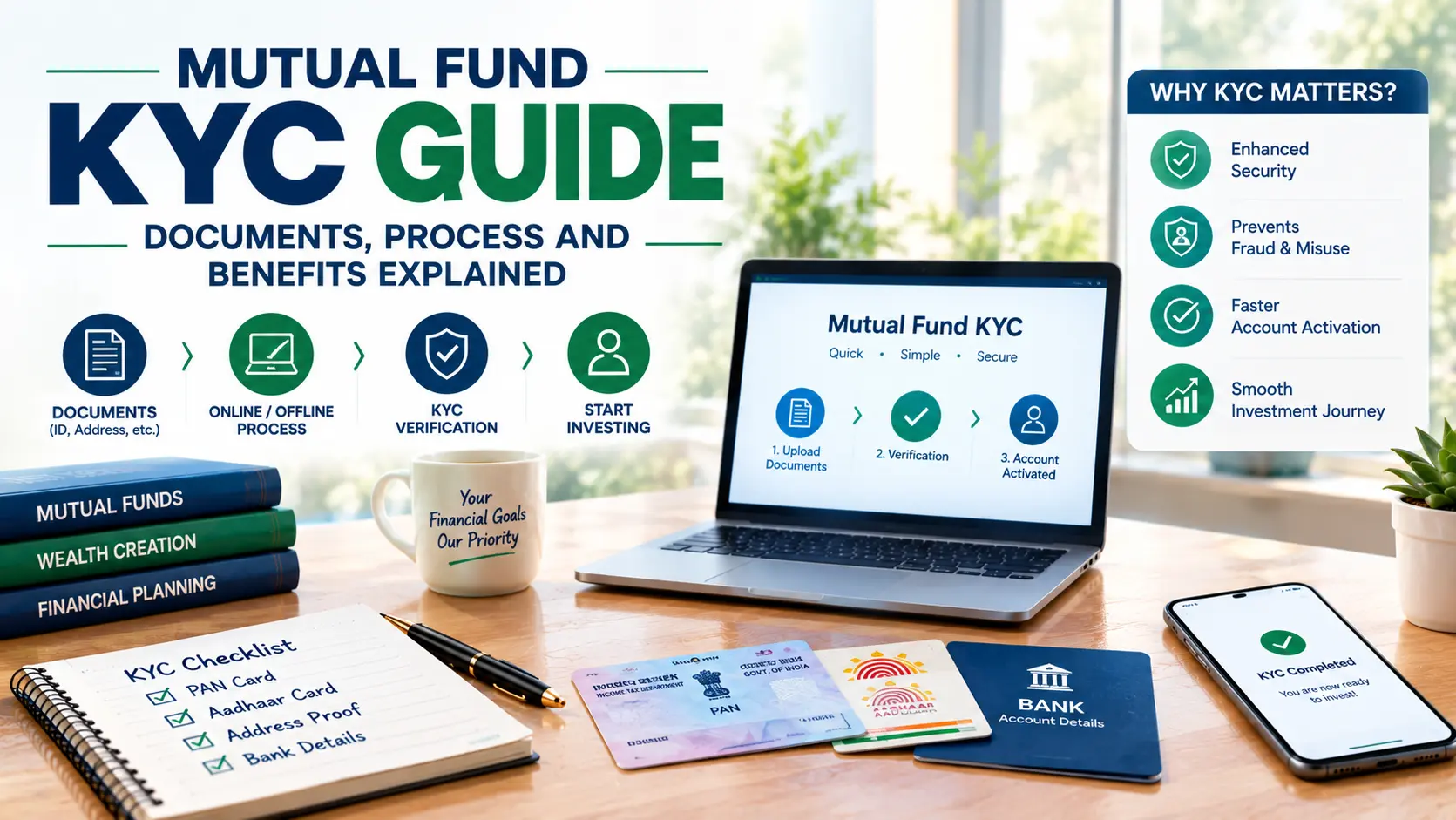
Mutual Fund KYC Guide: Documents, Process And Benefits Explained
Investing in Mutual Funds: Your Comprehensive KYC Guide
Before you begin investing in mutual funds, completing your Know Your Customer (KYC) process is mandatory. KYC helps verify your identity, prevents financial fraud and ensures compliance with regulatory requirements. Once your KYC is completed, you can invest in mutual funds across all Asset Management Companies (AMCs) without repeating the process.
What is KYC?
Know Your Customer (KYC) is a verification process that confirms an investor's identity and address before they can invest in financial products. It is a one-time process mandated by financial regulators to protect investors and maintain the integrity of the financial system.
Why is KYC Important?
Verifies your identity.
Prevents financial fraud and money laundering.
Ensures regulatory compliance.
Enables smooth mutual fund transactions.
Makes future investments simpler and faster.
Documents Required for KYC
To complete your KYC, you'll generally need the following documents:
1. Proof of Identity
You can submit any one of the following:
PAN Card (Mandatory for mutual fund investments)
Aadhaar Card
Passport
Driving Licence
Voter ID Card
2. Proof of Address
Accepted documents include:
Aadhaar Card
Passport
Driving Licence
Utility Bill
Bank Account Statement
Voter ID Card
3. Passport-Sized Photograph
A recent passport-size photograph is required for identification purposes.
Step-by-Step KYC Process
Step 1: Fill Out the KYC Form
Provide your personal information, including:
Full Name
Date of Birth
Address
Occupation
Income Details
Tax Residency Status
The form can be completed online or at the office of your financial institution or mutual fund distributor.
Step 2: Submit Your Documents
Attach clear copies of all the required documents along with your completed KYC form. Ensure that all information matches your official records to avoid delays.
Step 3: Complete Identity Verification
Depending on the institution, you may be required to complete:
In-Person Verification (IPV)
Video KYC
Aadhaar-based e-KYC
The verification process confirms your identity and validates the submitted documents.
Step 4: Check Your KYC Status
After successful verification, you can check your KYC status online through the relevant KYC Registration Agency (KRA) or your investment platform. Once approved, you're eligible to invest in mutual funds.
Benefits of Completing KYC
One-time verification process.
Access to all mutual fund schemes.
Faster investment process.
Enhanced security against fraud.
Easy online investment and redemption.
Common Mistakes to Avoid
Submitting unclear document copies.
Providing mismatched personal details.
Using expired identity documents.
Forgetting to sign the KYC form.
Entering incorrect PAN or Aadhaar details.
Conclusion
Completing your KYC is the first and most important step toward investing in mutual funds. It is a simple one-time process that safeguards your investments and enables seamless access to a wide range of financial products. By keeping your documents ready and ensuring accurate information, you can complete the process quickly and start your investment journey with confidence.
Frequently Asked Questions (FAQs)
1. Why is KYC mandatory for mutual fund investments?
KYC is required to verify the identity of investors, prevent financial fraud, and comply with regulatory guidelines issued by financial authorities.
2. Can I invest in mutual funds without completing KYC?
No. Completing KYC is mandatory before investing in any mutual fund scheme.
3. How long does the KYC process take?
The KYC process typically takes a few working days, depending on the institution and the accuracy of the submitted documents.
4. Do I need to complete KYC separately for every mutual fund?
No. KYC is a one-time process. Once you're KYC-compliant, you can invest in mutual funds across different Asset Management Companies (AMCs) without repeating it.
5. Is online KYC available?
Yes. Most AMCs and investment platforms offer online KYC through Aadhaar based e-KYC, Video KYC or digital verification, making the process faster and more convenient.