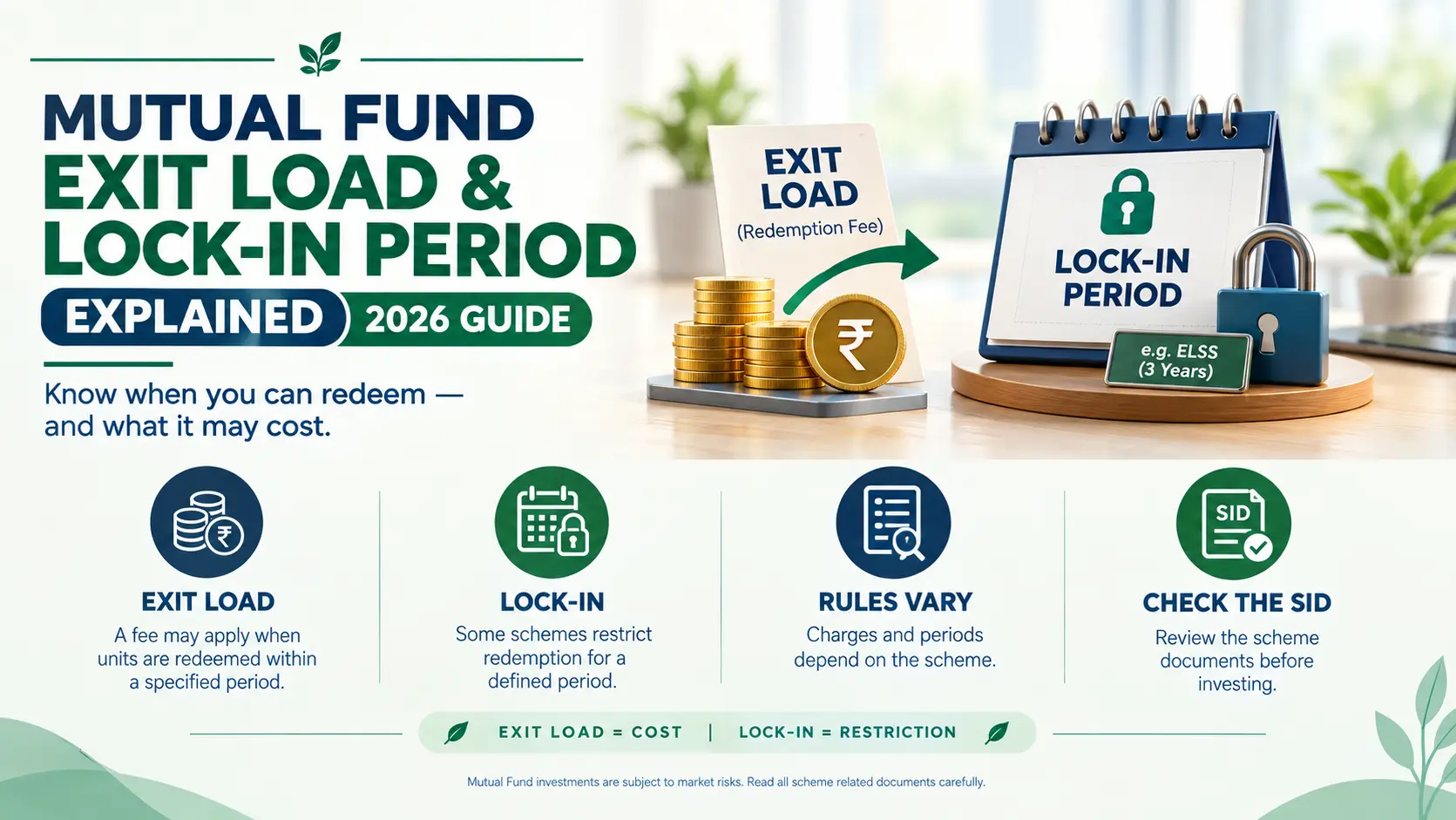
Mutual Fund Exit Load and Lock-in Period Explained (2026 Guide)
Mutual Fund Exit Load and Lock-in Period Explained (2026 Guide)
Understanding the Difference Before You Invest
Mutual funds are one of the most popular investment options for building long-term wealth. They offer professional fund management, diversification, and flexibility through both SIPs and lump sum investments.
However, before investing, every investor should understand two important concepts that can affect withdrawals:
- Exit Load
- Lock-in Period
Although these terms are often confused, they serve very different purposes. Understanding the difference can help you avoid unnecessary charges and choose investments that match your financial goals.
What is Exit Load in Mutual Funds?
An exit load is a fee charged by an Asset Management Company (AMC) when investors redeem their mutual fund units before a specified holding period.
The purpose of exit load is not to penalize investors, but to discourage short-term trading and protect the interests of long-term investors.
The exit load, if applicable, is deducted from the redemption amount before the proceeds are credited to your account.
Why Do Mutual Funds Charge Exit Load?
Exit loads help mutual funds maintain portfolio stability and reduce unnecessary transaction costs.
Some key reasons include:
Discouraging Short-Term Trading
Mutual funds are designed primarily for long-term wealth creation. Frequent buying and selling can disrupt portfolio management.
Protecting Existing Investors
Large redemptions may force fund managers to sell investments prematurely, potentially affecting returns for remaining investors.
Recovering Transaction Costs
Early withdrawals create administrative and transaction expenses, which are partially recovered through exit loads.
How is Exit Load Calculated?
Exit load is generally calculated as a percentage of the redemption value.
Example
Suppose you invest ₹50,000 in an equity mutual fund.
After 8 months, your investment grows to ₹55,000.
If the scheme charges an exit load of 1% for redemptions within one year, then:
- Redemption Value = ₹55,000
- Exit Load = 1% = ₹550
- Amount Received = ₹54,450
The remaining amount is paid to you after deducting the exit load.
Typical Exit Load Across Mutual Fund Categories
| Mutual Fund Type | Common Exit Load Structure |
|---|---|
| Equity Funds | Usually 1% if redeemed within 12 months (scheme-specific) |
| Debt Funds | Varies by scheme; may apply for early redemptions |
| Liquid Funds | Often no exit load or only for very short holding periods |
| Overnight Funds | Generally no exit load |
| Hybrid Funds | Depends on scheme |
| ELSS Funds | No exit load (because of mandatory lock-in) |
Note: Exit load varies from one mutual fund scheme to another. Always check the Scheme Information Document (SID) before investing.
What is a Lock-in Period?
A lock-in period is the minimum time during which your investment cannot be redeemed.
Unlike exit load, a lock-in period completely restricts withdrawals until the specified duration is over.
Even if you're willing to pay a fee, you generally cannot redeem your units before the lock-in ends.
Why Do Some Mutual Funds Have a Lock-in Period?
Lock-in periods are introduced for specific investment objectives.
Encourage Long-Term Investing
Long-term investing helps investors benefit from compounding and reduces emotional decision-making.
Portfolio Stability
A fixed investment horizon allows fund managers to execute long-term investment strategies more effectively.
Tax Benefits
Some schemes provide tax deductions in exchange for a mandatory lock-in period.
Mutual Funds That Have Lock-in Periods
ELSS (Equity Linked Savings Scheme)
- Mandatory 3-year lock-in
- Eligible for tax deduction under Section 80C
- Shortest lock-in among tax-saving investment options under Section 80C.
Close-Ended Mutual Funds
Investments remain locked until the maturity of the scheme, typically ranging from 3 to 5 years.
Certain Retirement or Pension-Oriented Funds
Some retirement-focused mutual fund schemes have restrictions on withdrawals until retirement age or completion of a specified holding period.
Exit Load vs Lock-in Period
| Feature | Exit Load | Lock-in Period |
|---|---|---|
| Meaning | Fee charged for early redemption | Withdrawal restriction |
| Can you withdraw? | Yes | No (until lock-in ends) |
| Applies to | Many open-ended schemes | Selected schemes only |
| Purpose | Discourage early redemption | Encourage long-term investing |
| Mandatory? | Depends on scheme | Applicable only for specific schemes |
Tips to Avoid Exit Load
Stay Invested for the Recommended Holding Period
Redeem only after the exit load period expires whenever possible.
Read the Scheme Information
Always check the exit load structure before investing.
Match Investments With Your Goals
If you may need money soon, consider schemes with minimal or no exit load.
Build an Emergency Fund
Having separate emergency savings reduces the need to redeem mutual fund investments prematurely.
Should Exit Load Stop You From Investing?
Not necessarily.
Exit loads are generally small and temporary. They encourage disciplined investing rather than frequent trading.
If you're investing with long-term goals such as retirement, children's education, or wealth creation, you'll likely remain invested well beyond the exit load period, making it largely irrelevant.
Instead of focusing only on exit loads, consider:
- Investment objective
- Risk level
- Portfolio quality
- Fund manager's track record
- Expense ratio
- Long-term performance
Conclusion
Understanding the difference between exit load and lock-in period is essential before investing in mutual funds.
An exit load is a charge for redeeming your investment early, whereas a lock-in period prevents withdrawals altogether for a specified duration.
Neither should discourage you from investing. Instead, they should encourage thoughtful financial service and long term discipline.
Before investing in any mutual fund, always review the scheme documents, understand the applicable charges and ensure the investment aligns with your financial goals and liquidity needs.
Frequently Asked Questions (FAQs)
1. Can I withdraw my mutual fund investment before the lock-in period ends?
Generally, no. If your investment is subject to a lock-in period (such as ELSS), you cannot redeem the units until the lock-in expires.
2. Do all mutual funds charge an exit load?
No. Exit loads vary by scheme. Some mutual funds, including many overnight and certain liquid funds, may not charge any exit load, while others impose one for early redemptions.
3. How can I avoid paying an exit load?
The simplest way is to remain invested beyond the exit load period mentioned in the Scheme Information Document (SID). Matching your investments with your financial needs and cash flow requirements can help minimize avoidable expenses.