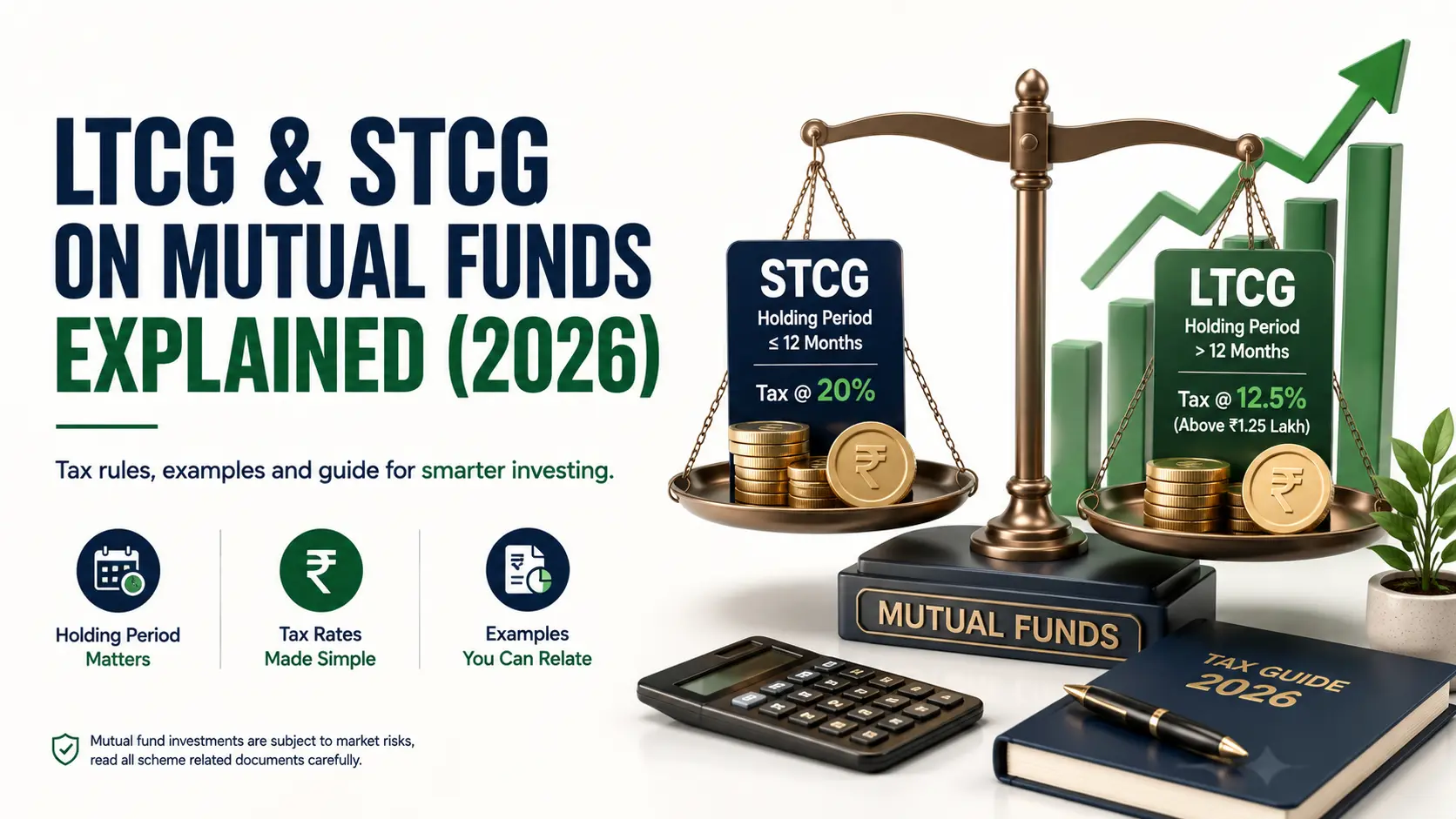
LTCG & STCG on Mutual Funds Explained (2026): Tax Rules, Examples And Guide
LTCG & STCG on Mutual Funds Explained (2026 Guide): Tax Rules Every Investor Should Know
Mutual funds have become one of the most popular investment options for Indian investors due to their simplicity, diversification, and long term wealth creation potential. However, while many investors focus on returns, they often overlook one important aspect taxation.
Understanding Long Term Capital Gains (LTCG) and Short Term Capital Gains (STCG) is essential because taxes directly affect your actual returns. Whether you invest through SIPs or lump sum investments, knowing how mutual fund gains are taxed can help you make better financial decisions and avoid surprises at the time of redemption.
In this guide, we'll explain LTCG and STCG on mutual funds in simple language, the latest tax rules applicable in 2026 and practical examples to help you understand how taxation works.
What Are Capital Gains?
A capital gain is the profit you earn when you sell or redeem your mutual fund units for more than your purchase price.
For example:
Investment Amount: ₹2,00,000
Redemption Value: ₹2,50,000
Capital Gain: ₹50,000
The tax you pay on this ₹50,000 depends on:
The type of mutual fund.
How long you held the investment before selling it.
This holding period determines whether your gains are classified as Short Term Capital Gains (STCG) or Long Term Capital Gains (LTCG).
What is STCG (Short-Term Capital Gain)?
STCG refers to profits earned when mutual fund units are sold before completing the prescribed holding period.
The applicable holding period differs depending on the type of mutual fund.
For Equity Mutual Funds
If units are sold within 12 months, the gains are considered Short Term Capital Gains.
Tax Rate
20% STCG Tax (plus applicable surcharge and cess)
Example
Rahul invested ₹1,00,000 in an equity mutual fund.
After 8 months, the investment grew to ₹1,20,000.
Capital Gain = ₹20,000
Since the investment was sold within one year:
Taxable Gain = ₹20,000
STCG Tax = ₹4,000 (excluding surcharge and cess)
What is LTCG (Long Term Capital Gain)?
LTCG applies when mutual fund investments are held beyond the specified holding period.
For Equity Mutual Funds
If units are sold after 12 months, the gains qualify as Long Term Capital Gains.
Tax Rule
Annual LTCG exemption up to ₹1.25 lakh
Gains exceeding ₹1.25 lakh are taxed at 12.5%
Example
Investment Amount = ₹5,00,000
Value After 5 Years = ₹7,50,000
Capital Gain = ₹2,50,000
Tax Calculation:
First ₹1.25 lakh = Tax Free
Remaining ₹1.25 lakh = Taxed at 12.5%
Tax = ₹15,625 (excluding surcharge and cess)
Taxation for Debt Mutual Funds
Debt mutual fund taxation differs from equity funds.
For many debt-oriented mutual funds purchased under the current tax rules, capital gains are generally taxed according to the investor's applicable income tax slab, regardless of the holding period.
Since taxation rules for debt funds have undergone significant changes in recent years, investors should verify the applicable rules based on the date of investment and the nature of the fund before making redemption decisions.
Holding Period for Different Mutual Funds
| Mutual Fund Type | STCG Holding Period | LTCG Holding Period |
|---|---|---|
| Equity Mutual Funds | Less than 12 months | More than 12 months |
| Debt Mutual Funds | Tax treatment depends on prevailing tax provisions | Refer to applicable tax rules based on investment date |
How SIP Investments Are Taxed
One of the biggest misconceptions among investors is that an SIP is treated as a single investment.
In reality, every SIP installment is considered a separate investment.
Each installment has:
Its own purchase date
Its own holding period
Its own tax calculation
Example
Suppose you invest ₹10,000 every month through SIP.
After two years, you redeem ₹2,40,000.
The first SIP installment has completed more than one year.
The later installments may still fall within one year.
As a result:
Some units may qualify for LTCG.
Some units may attract STCG.
This is why SIP taxation can be more complex than lump sum investments.
How Mutual Fund Taxes Are Calculated
Tax calculation depends on four simple factors:
Step 1
Determine the purchase cost.
Step 2
Determine the redemption value.
Step 3
Calculate capital gains.
Capital Gain = Redemption Value – Purchase Cost
Step 4
Check the holding period to identify whether the gain is STCG or LTCG.
The applicable tax rate is then applied.
Ways to Reduce Mutual Fund Tax Liability
While taxes cannot always be avoided, investors can manage them efficiently by planning redemptions.
Some commonly followed approaches include:
Hold equity mutual funds for more than one year whenever suitable.
Use the annual LTCG exemption strategically.
Redeem investments gradually instead of all at once, where appropriate.
Keep records of SIP purchase dates.
Avoid unnecessary short term redemptions.
Review tax implications before switching between mutual fund schemes.
Proper planning can improve post tax returns over the long term.
Common Mistakes Investors Make
Many investors unintentionally pay more tax due to a lack of awareness.
Some common mistakes include:
Redeeming investments just before completing one year.
Assuming all SIP units have the same purchase date.
Ignoring tax implications while switching mutual funds.
Focusing only on returns instead of post tax returns.
Not maintaining proper investment records.
Avoiding these mistakes can help improve overall investment efficiency.
Frequently Asked Questions (FAQs)
Is LTCG on mutual funds tax free?
For equity mutual funds, long term capital gains up to ₹1.25 lakh in a financial year are exempt. Gains above this limit are taxed at 12.5%.
Is STCG higher than LTCG?
Yes. For equity mutual funds, STCG is taxed at 20%, whereas LTCG above the exemption limit is taxed at 12.5%.
Does every SIP installment have a different tax calculation?
Yes. Every SIP installment is treated as a separate investment with its own holding period and tax treatment.
Is switching from one mutual fund to another taxable?
Yes. A switch is treated as a redemption followed by a fresh investment, which may result in capital gains tax depending on the holding period and applicable tax rules.
Do dividends from mutual funds attract tax?
Mutual fund income distributions are generally taxable in the hands of investors according to the prevailing tax rules and their applicable income tax slab.
Conclusion
Understanding LTCG and STCG on mutual funds is just as important as selecting the right investment. Taxes directly impact your net returns, and even a well performing portfolio can deliver lower post tax gains if redemptions are not planned efficiently.
By knowing the difference between short term and long-term capital gains, tracking SIP holding periods, and understanding the latest tax rules, investors can make more informed decisions and improve overall investment outcomes.
Whether you're a first time investor or building long term wealth through SIPs, keeping taxation in mind can help you maximize your returns while staying compliant with current regulations.