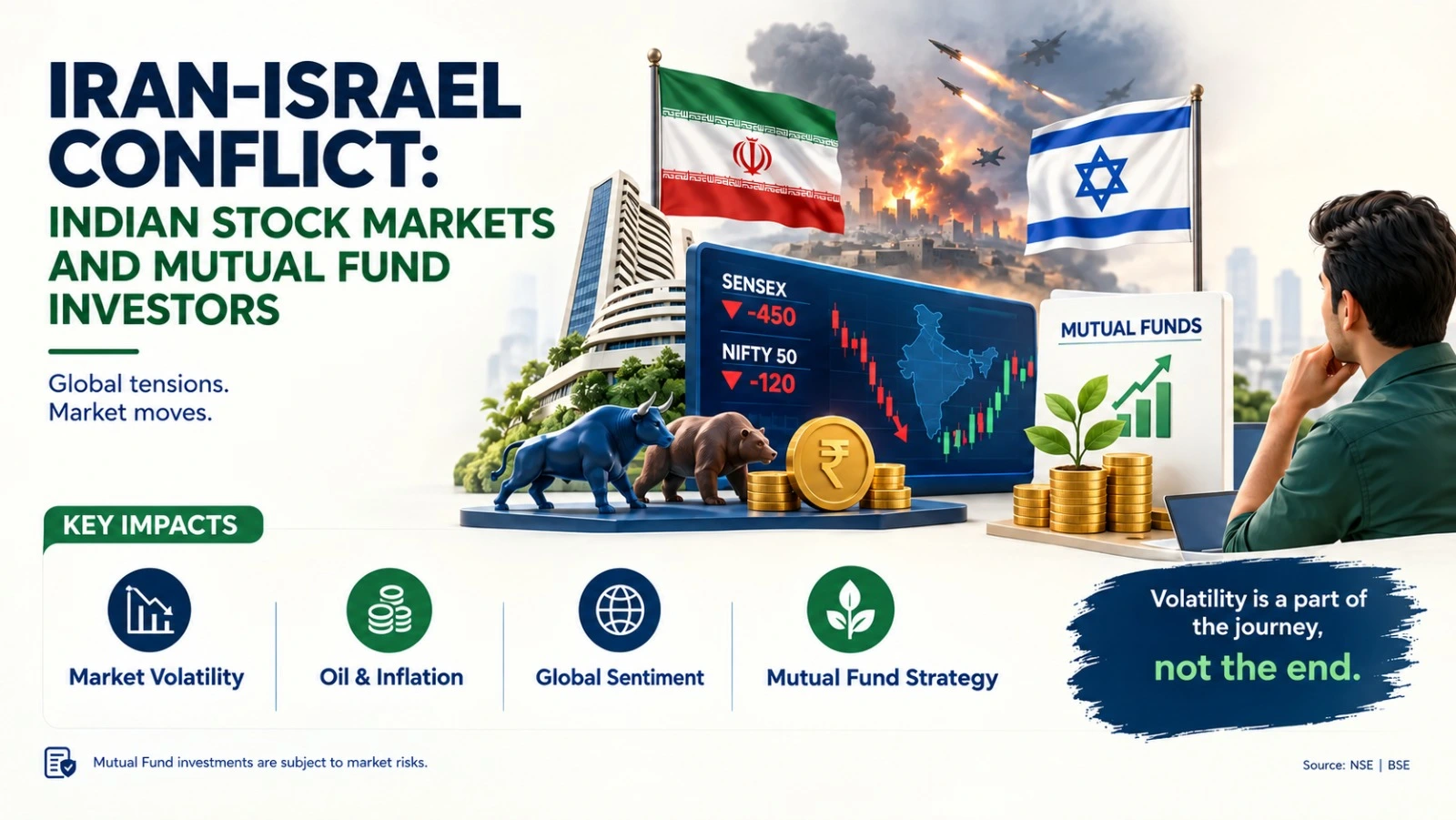
Iran-Israel Conflict: Indian Stock Markets and Mutual Fund Investors
Iran-Israel Conflict: What It Means for Indian Stock Markets and Mutual Fund Investors
Geopolitical events often create uncertainty in global financial markets, and the Iran-Israel conflict is no exception. Escalating tensions in the Middle East can influence oil prices, currency movements, investor sentiment, and stock markets across the world—including India.
For mutual fund investors, periods like these can be unsettling. Sharp market swings often lead many investors to question whether they should stop their SIPs, switch funds, or wait on the sidelines.
The good news is that while geopolitical events may trigger short-term volatility, long-term investing principles remain largely unchanged. Understanding how such events impact markets can help you make informed decisions instead of reacting emotionally.
In this article, we'll explore how the Iran-Israel conflict can affect the Indian economy, stock markets, and mutual fund investments—and discuss practical strategies investors can consider during periods of uncertainty.
Why Does the Iran-Israel Conflict Matter to India?
Although India is not directly involved in the conflict, the country's economy is closely connected to global trade and energy markets.
The Middle East is one of the world's largest oil-producing regions, and India imports a significant portion of its crude oil requirements. Any disruption to oil production, shipping routes, or regional stability can have ripple effects on inflation, business costs, and financial markets.
In addition, geopolitical uncertainty often changes global investor sentiment, leading to increased volatility across equity markets.
How Geopolitical Conflicts Affect Indian Stock Markets
1. Increased Market Volatility
Financial markets dislike uncertainty.
When geopolitical tensions escalate, investors often become risk-averse, resulting in increased buying and selling activity. This can lead to sharp short-term movements in benchmark indices such as the Nifty 50 and Sensex.
Foreign Portfolio Investors (FPIs) may also reduce exposure to emerging markets during periods of global uncertainty, adding to market volatility.
However, history suggests that markets generally recover once uncertainty begins to ease.
2. Rising Crude Oil Prices
One of the biggest concerns during Middle East conflicts is the impact on crude oil prices.
India imports the majority of its crude oil, making higher oil prices a challenge for the economy.
An increase in crude oil prices can lead to:
- Higher transportation costs
- Rising manufacturing expenses
- Increased inflation
- Pressure on corporate profitability
- Reduced consumer spending
Sectors such as aviation, logistics, paints, chemicals, and transportation often feel the impact more directly.
3. Pressure on the Indian Rupee
Higher crude oil imports increase India's demand for US dollars, which can put pressure on the Indian Rupee.
A weaker rupee makes imports more expensive and may contribute to inflation. However, export-oriented sectors such as Information Technology and pharmaceuticals may benefit from currency depreciation, partially offsetting the impact.
How the Conflict Can Affect Mutual Fund Investments
Equity Mutual Funds
Equity mutual funds are generally the first to reflect market volatility.
During geopolitical uncertainty, investors may witness temporary declines in portfolio values, particularly in:
- Mid Cap Funds
- Small Cap Funds
- Sectoral Funds
Large Cap Funds often experience relatively lower volatility due to their exposure to established companies, although they are not immune to market fluctuations.
It's important to remember that temporary declines are a normal part of equity investing.
Debt Mutual Funds
Debt mutual funds react differently.
Inflation expectations, interest rate movements, and bond yields influence their performance.
In uncertain market conditions, investors often move towards relatively safer fixed-income instruments. Depending on the interest rate environment, certain categories such as short-duration debt funds or government securities may experience comparatively lower volatility.
Investors should choose debt funds based on their investment horizon and risk profile rather than short-term market events.
Gold Mutual Funds and Gold ETFs
Gold has historically been viewed as a defensive asset during periods of geopolitical uncertainty.
When global risks increase, demand for gold often rises, which may support the performance of Gold ETFs and Gold Mutual Funds.
While gold can help diversify a portfolio, it should complement—not replace—a well-balanced long-term investment strategy.
What Should Mutual Fund Investors Do?
Market volatility can be uncomfortable, but emotional decisions often hurt long-term returns more than market corrections themselves.
Here are some sensible strategies investors can consider.
1. Stay Focused on Long-Term Goals
If you're investing for retirement, your child's education, or long-term wealth creation, avoid making decisions based solely on short-term headlines.
Market corrections are temporary, whereas financial goals often span several years.
2. Continue Your SIPs
Stopping SIPs during market declines can mean missing opportunities to accumulate more units at lower Net Asset Values (NAVs).
One of the key benefits of SIP investing is rupee cost averaging, where regular investments purchase more units when prices are lower and fewer units when prices are higher.
Over the long term, this disciplined approach can help smooth the impact of market volatility.
3. Maintain a Diversified Portfolio
Diversification remains one of the most effective ways to manage investment risk.
A balanced portfolio may include an appropriate mix of:
- Equity Mutual Funds
- Debt Mutual Funds
- Gold Investments
- International Exposure (where suitable)
The right asset allocation depends on your financial goals, investment horizon, and risk tolerance.
4. Avoid Trying to Time the Market
Predicting how markets will react to geopolitical developments is extremely difficult.
Rather than attempting to buy at the lowest point or sell before every decline, investors are generally better served by maintaining a disciplined investment strategy and reviewing their portfolios periodically.
Lessons from Past Global Conflicts
History shows that financial markets have navigated numerous geopolitical crises, including:
- The Gulf War
- The Russia-Ukraine conflict
- The COVID-19 pandemic
- Previous Middle East tensions
While each event created short-term volatility, markets have historically recovered over time as economic activity normalized and investor confidence returned.
Although past performance does not guarantee future results, these episodes highlight the importance of maintaining a long-term perspective during periods of uncertainty.
Final Thoughts
Geopolitical conflicts such as the Iran-Israel situation can create temporary uncertainty in financial markets, but they should not derail a well-planned investment strategy.
Instead of reacting to daily headlines, investors should focus on their long-term financial goals, maintain diversification, continue disciplined investing through SIPs where appropriate, and periodically review their portfolios.
At Moneytree Partners, we help investors navigate changing market conditions with personalized, goal-based investment strategies. Whether markets are rising or experiencing short-term volatility, disciplined investing and informed decision-making remain the foundation of long-term wealth creation.
Mutual Fund investments are subject to market risks. Please read all scheme-related documents carefully before investing. Past performance is not indicative of future results.
Frequently Asked Questions (FAQs)
1. Should I stop my SIP during geopolitical conflicts like the Iran-Israel situation?
Generally, long-term investors should avoid making investment decisions based solely on short-term geopolitical events. Continuing SIPs during market declines may help investors benefit from rupee cost averaging.
2. Can geopolitical conflicts affect Indian mutual funds?
Yes. Geopolitical events can influence equity markets, interest rates, crude oil prices, inflation, and investor sentiment, which may impact the performance of different mutual fund categories in the short term.
3. Which mutual funds may be relatively more resilient during periods of market uncertainty?
No mutual fund is completely risk-free. Depending on market conditions and individual financial goals, investors may consider diversified equity funds, short-duration debt funds, balanced advantage funds, or gold-based funds as part of a well-diversified portfolio. Investment decisions should always be aligned with individual risk tolerance and financial objectives.
4. Will Indian stock markets recover after geopolitical tensions ease?
While no one can predict market movements with certainty, history shows that equity markets have generally recovered from major geopolitical events over the long term. Investors should avoid making decisions based solely on short-term market movements.
5. How should I prepare my portfolio for uncertain market conditions?
Focus on maintaining an appropriate asset allocation, diversifying across asset classes, continuing disciplined investments where suitable, and reviewing your portfolio periodically with a qualified financial professional.