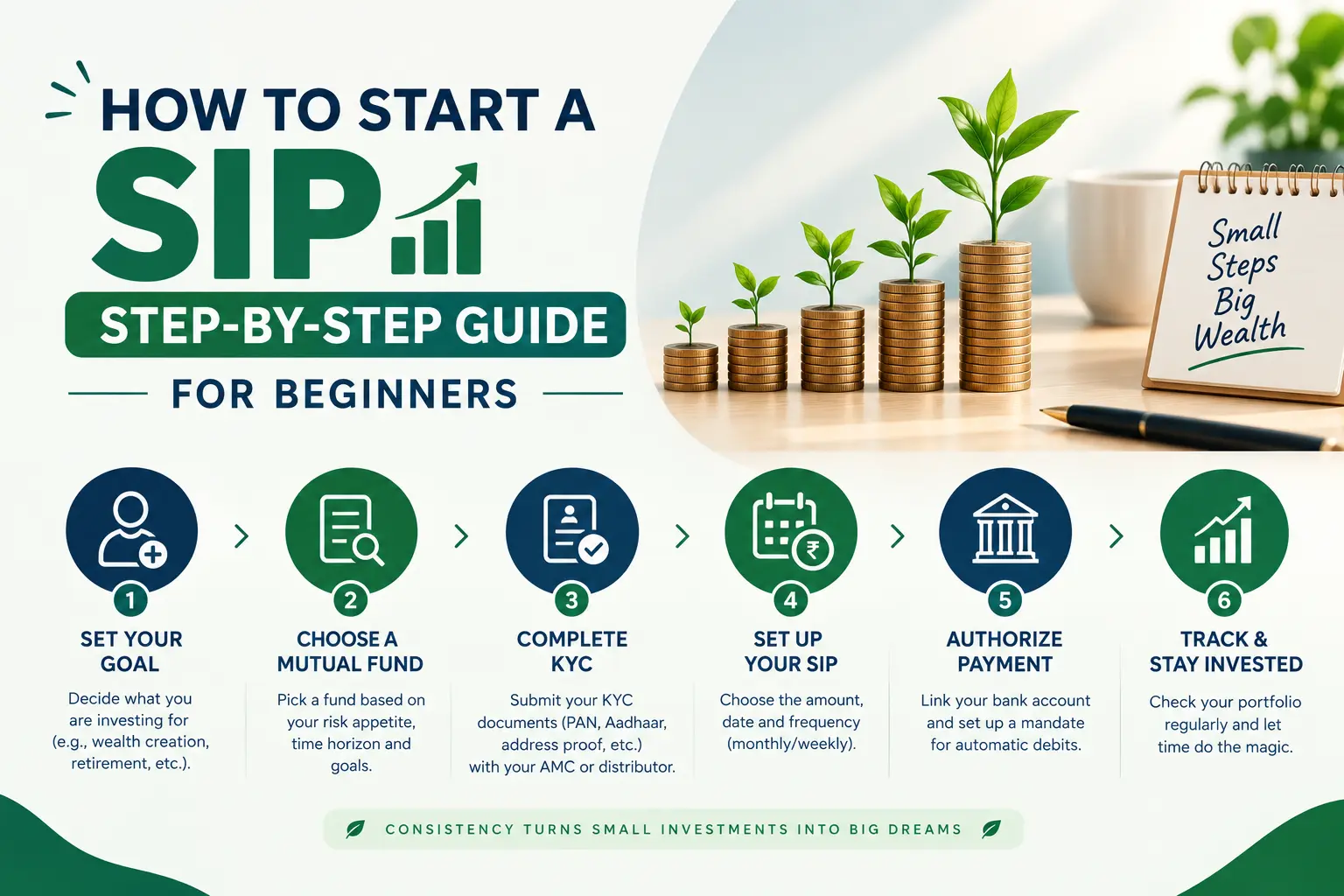
How to Start a SIP: Step-by-Step Guide for Beginners
How to Start a SIP: A Step-by-Step Guide for Beginners
Investing doesn't have to be complicated. One of the easiest and most effective ways to begin your investment journey is through a Systematic Investment Plan (SIP). Whether you're a young professional, a first-time investor, or someone planning for long-term financial goals, a SIP helps you invest regularly without requiring a large initial investment.
Instead of waiting for the "right time" to invest, SIPs encourage disciplined investing by allowing you to contribute a fixed amount at regular intervals. Over the long term, this approach can help you benefit from the power of compounding and reduce the impact of short-term market fluctuations.
In this guide, we'll walk you through the complete process of starting a SIP from setting your financial goals to choosing the right mutual fund and tracking your investments.
What is a SIP?
A Systematic Investment Plan (SIP) is a method of investing in mutual funds where you invest a fixed amount at regular intervals, usually every month. Instead of making a one-time lump sum investment, SIPs allow you to build wealth gradually while developing a disciplined investment habit.
Since mutual funds invest in market-linked securities, the value of your investment can fluctuate. However, investing consistently over a long period helps reduce the impact of market volatility through rupee cost averaging and gives your investments more time to benefit from compounding.
Key Benefits of SIPs
- Start investing with a small amount every month.
- Develop a disciplined investment habit.
- Benefit from the power of compounding over the long term.
- Reduce the need to time the market.
- Enjoy the advantage of rupee cost averaging during market fluctuations.
- Increase your SIP amount as your income grows through Step-Up SIPs.
Why Should You Invest Through a SIP?
SIPs have become one of the most preferred investment options because they are simple, flexible and suitable for investors at different stages of life.
Some of the key advantages include:
- You can start with a modest monthly investment, depending on the mutual fund's minimum investment requirement.
- Investments are automatically deducted from your bank account, making the process convenient.
- SIPs help you stay invested during both rising and falling markets.
- They are ideal for long-term goals such as retirement planning, children's education, wealth creation or buying a home.
Step-by-Step Guide to Start a SIP
Step 1: Define Your Financial Goals
Before investing, identify why you want to invest.
Ask yourself:
- Are you saving for retirement?
- Planning your child's education?
- Building wealth for financial independence?
- Buying a home or a car?
Having a clear financial goal helps determine the right investment horizon and the type of mutual fund suitable for your needs.
Step 2: Complete Your KYC
Completing your Know Your Customer (KYC) process is mandatory before investing in mutual funds in India.
You'll generally need:
- PAN Card
- Aadhaar Card
- Passport-size photograph
- Bank account proof (cancelled cheque or bank statement)
Today, most investors can complete e-KYC online using Aadhaar-based verification, making the process quick and convenient.
Step 3: Choose the Right Mutual Fund
Selecting the right mutual fund is one of the most important decisions you'll make.
Your choice should depend on:
- Your financial goals
- Investment horizon
- Risk appetite
- Asset allocation
For example:
- Debt Funds may be suitable for short-term goals.
- Hybrid Funds can be considered by investors seeking a balance between equity and debt.
- Equity Mutual Funds are generally preferred for long-term wealth creation, keeping in mind that they carry higher market risk.
- ELSS Funds may be considered by investors seeking tax benefits under applicable tax laws while investing for the long term.
If you're unsure which fund suits your needs, consulting a qualified mutual fund distributor or financial advisor can help you make an informed decision.
Step 4: Decide Your SIP Amount
One of the biggest advantages of SIP investing is that you don't need a large amount to get started.
Choose an investment amount that comfortably fits your monthly budget and financial commitments.
As your income increases, consider gradually increasing your SIP through a Step-Up SIP, which can significantly improve your long-term wealth creation.
Step 5: Select Your SIP Date and Investment Duration
Choose a SIP date that aligns with your salary or regular cash flow so that maintaining the investment becomes easier.
For long-term financial goals, remaining invested for several years generally provides more opportunities for compounding to work in your favour.
Remember, consistency often matters more than trying to predict market movements.
Step 6: Register Your Auto-Debit Mandate
To ensure your SIP investments continue without interruption, set up an auto-debit mandate from your bank account.
This can typically be done using:
- Net Banking
- UPI Autopay (where available)
- NACH Mandate
Automating your investments helps maintain discipline and avoids missing SIP instalments.
Step 7: Monitor Your Investments Regularly
Starting a SIP is only the beginning.
Review your portfolio at least once a year to ensure your investments remain aligned with your financial goals.
Avoid reacting to short-term market volatility. Instead, focus on your long-term investment plan and make changes only when your goals, financial situation or risk profile change.
How Much Can a SIP Grow?
Suppose you invest ₹2,000 every month for 10 years.
Your total investment would be ₹2.4 lakh.
If your investments were to earn an assumed annual return of 12%, the investment value could grow to approximately ₹4.6–₹4.7 lakh.
Please note: Mutual fund returns are market-linked and not guaranteed. Actual returns may be higher or lower depending on market performance.
Common Mistakes to Avoid While Starting a SIP
Many first-time investors make avoidable mistakes that can affect their long-term wealth creation.
Avoid these common errors:
- Starting without a clear financial goal.
- Choosing funds solely based on past performance.
- Stopping SIPs during temporary market declines.
- Investing more than your monthly budget allows.
- Ignoring annual portfolio reviews.
- Not increasing your SIP as your income grows.
Final Thoughts
Starting a SIP is one of the simplest ways to begin your investment journey. By investing regularly, staying disciplined, and remaining invested for the long term, you can work towards achieving important financial goals without needing to time the market.
Whether you are planning for retirement, your child's education, buying a home or creating long-term wealth, a well-planned SIP can become an important part of your financial strategy.
At Moneytree Partners, we help investors choose mutual funds that align with their financial goals, risk appetite, and investment horizon. From completing KYC to building a diversified portfolio and reviewing it periodically, our team is here to support you at every stage of your investment journey.
Mutual Fund investments are subject to market risks. Read all scheme-related documents carefully before investing.
Frequently Asked Questions (FAQs)
1. Can I stop or pause my SIP anytime?
Yes. Most SIPs offer flexibility, allowing you to pause, modify or stop your SIP by following the fund house's or investment platform's process.
2. What happens if I miss a SIP instalment?
If your bank account has insufficient funds, the SIP instalment may not be processed. Repeated missed instalments could result in the SIP being discontinued, depending on the fund house's policies.
3. Is SIP suitable for beginners?
Yes. SIPs are considered one of the most beginner-friendly investment methods because they encourage disciplined investing and reduce the need to time the market.
4. Can I increase my SIP amount later?
Yes. Many fund houses offer a Step-Up SIP facility, allowing you to increase your investment amount periodically as your income grows.
5. How long should I continue a SIP?
There is no fixed duration. Generally, the longer you remain invested especially for long-term goals the greater the opportunity to benefit from compounding. The appropriate investment period should depend on your financial goals and risk tolerance.