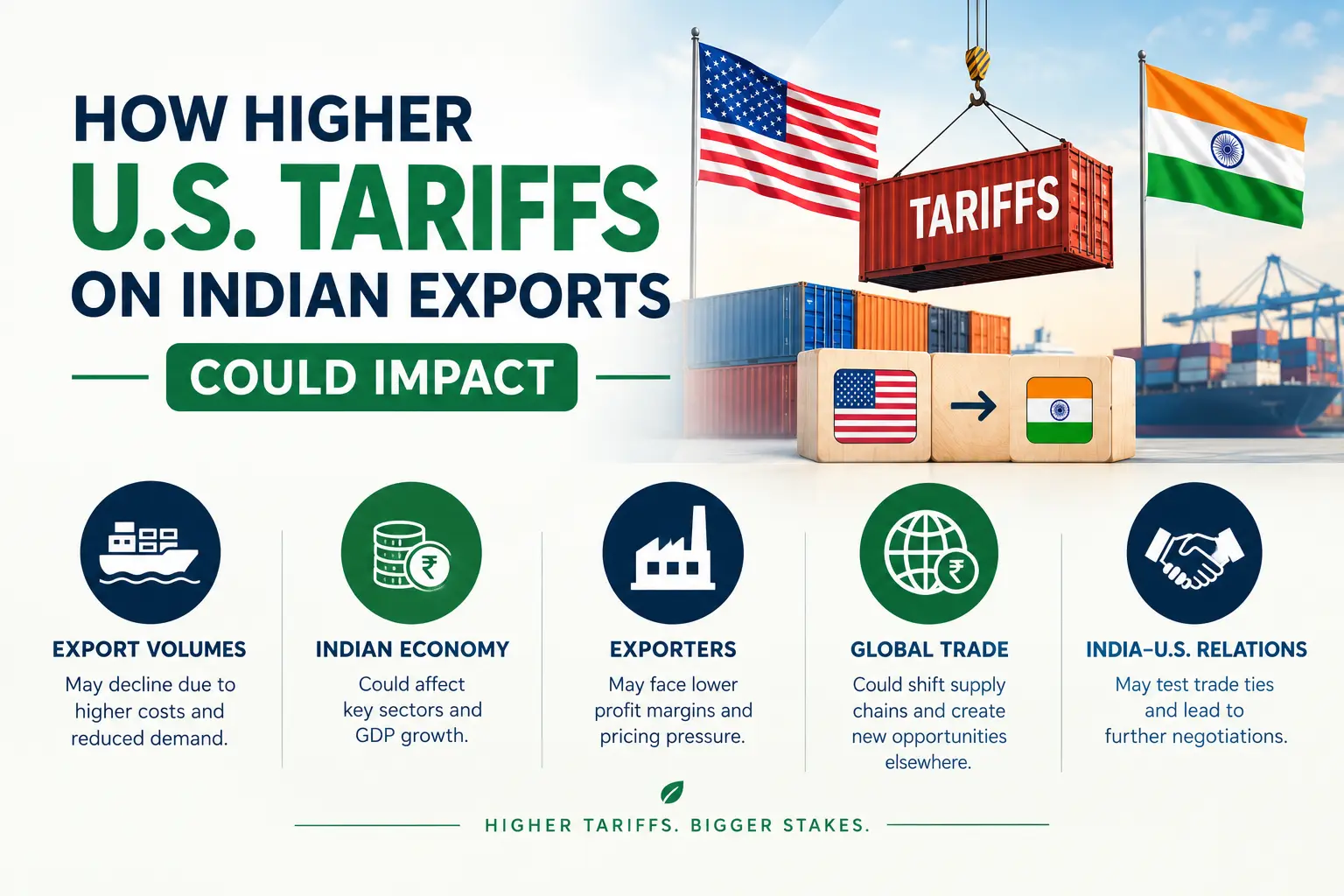
How Higher U.S. Tariffs on Indian Exports Could Impact
How Higher U.S. Tariffs on Indian Exports Could Impact Mutual Fund Investors
Global markets rarely move in isolation. A policy decision taken thousands of kilometres away can influence stock markets, business sentiment, and investment portfolios across the world. The recent increase in U.S. tariffs on several Indian exports is one such development that has attracted the attention of businesses, policymakers, and investors alike.
While the immediate focus has been on exporters, manufacturers, and trade relations between India and the United States, mutual fund investors are naturally asking an important question:
Will these tariffs affect my investments?
The answer isn't as straightforward as a simple yes or no.
Higher tariffs can create short-term pressure on specific industries, but they do not necessarily change India's long-term economic story. In fact, periods of market uncertainty often reinforce the importance of diversification, disciplined investing, and maintaining a long-term perspective.
In this article, we'll explain what the latest tariff developments mean, which sectors could be affected, and how mutual fund investors can respond without making emotional investment decisions.
Understanding the Latest U.S. Tariffs
Trade relationships between countries are shaped by economic interests, diplomatic priorities, and geopolitical developments. During the recent trade dispute between India and the United States, the U.S. announced higher tariffs on several categories of Indian exports.
The policy particularly affected export-oriented industries such as:
- Textiles and apparel
- Gems and jewellery
- Auto components
- Engineering goods
- Certain pharmaceutical products
- Industrial manufacturing
The tariff measures were introduced alongside broader geopolitical concerns, including India's continued purchase of Russian crude oil. As a result, several Indian exporters now face increased costs when selling products in the U.S. market.
Although these developments have created uncertainty, it is important to remember that tariffs are policy tools rather than permanent economic realities. Trade negotiations, diplomatic discussions, and changes in government policy can alter these measures over time.
For investors, the key takeaway is not to react to headlines but to understand how these developments influence different sectors of the economy.
Why Do Tariffs Matter for Mutual Fund Investors?
Most mutual fund investors do not own export companies directly. Instead, they invest through professionally managed portfolios that hold dozens or even hundreds of stocks across multiple industries.
However, tariffs can still influence fund performance in several ways.
Pressure on Export-Oriented Companies
Companies that generate a significant share of their revenue from exports to the U.S. may experience:
- Higher operating costs
- Reduced pricing competitiveness
- Lower export demand
- Pressure on profit margins
Mutual funds with significant exposure to these businesses could experience short-term volatility if earnings expectations weaken.
That said, many diversified equity funds invest across sectors rather than concentrating on a single industry. This diversification can help reduce the impact of weakness in any one segment.
Market Sentiment Often Reacts Before Fundamentals
Financial markets tend to react quickly to major policy announcements.
Even companies that are not directly affected by tariffs may witness temporary declines as investors become cautious.
Such periods of volatility are common during geopolitical events and trade disputes. While short-term market movements can be uncomfortable, they do not always reflect the long-term earnings potential of businesses.
History has shown that markets generally adapt as companies adjust their supply chains, diversify export destinations, and improve operational efficiency.
Which Sectors Could Feel the Greatest Impact?
Although every business is unique, some industries are naturally more exposed to changes in international trade policies.
Textiles and Apparel
The textile industry is among India's largest export sectors.
Higher tariffs may reduce the price competitiveness of Indian products in overseas markets, especially if buyers shift to countries facing lower trade barriers.
Companies heavily dependent on U.S. exports could experience slower revenue growth if tariff costs cannot be passed on to customers.
Auto Components
India has become an important manufacturing hub for automobile parts supplied to global manufacturers.
Higher import duties may increase costs for U.S. buyers, potentially affecting export volumes in the short term.
However, many leading Indian auto component companies have diversified customer bases across Europe, Asia, and other international markets, reducing dependence on a single geography.
Gems and Jewellery
The gems and jewellery sector has traditionally relied on exports to major international markets.
Tariff-related cost increases may temporarily affect demand, particularly in price-sensitive product categories.
Companies with strong brand recognition and diversified export destinations may be better positioned to navigate these challenges.
Pharmaceuticals
India remains one of the world's largest suppliers of generic medicines.
Although some pharmaceutical exports may face additional trade-related challenges, the sector continues to benefit from long-term structural demand driven by healthcare needs across global markets.
Investors should remember that pharmaceutical companies differ significantly in product mix, regulatory exposure, and geographic revenue sources.
Sectors That May Demonstrate Greater Resilience
While export-oriented industries could face temporary pressure, several domestically driven sectors may remain relatively insulated from international trade disruptions.
Banking and Financial Services
India's banking sector is largely supported by domestic credit demand, retail lending, and economic activity within the country.
As consumer spending and business investment continue, financial institutions may remain less affected by export-related headwinds than manufacturing companies.
Consumer Goods
Businesses serving India's large domestic population are influenced more by household consumption than overseas demand.
Fast-moving consumer goods (FMCG), retail, and essential products often demonstrate relatively stable demand even during periods of global uncertainty.
Infrastructure
Government investment in roads, railways, renewable energy, urban development, and logistics continues to create opportunities across infrastructure-related businesses.
Long-term public spending initiatives are driven primarily by domestic economic priorities rather than international trade.
Healthcare Services
Hospitals, diagnostics, healthcare providers, and domestic healthcare companies continue to benefit from rising healthcare awareness and increasing demand within India.
Although individual businesses may face sector-specific challenges, domestic healthcare demand remains supported by long-term demographic trends.
Diversification Becomes Even More Important
One of the biggest advantages of investing through mutual funds is diversification.
Rather than relying on a single company or industry, diversified equity funds spread investments across multiple sectors and businesses.
This approach helps reduce the impact of adverse events affecting one part of the economy.
For example, if export-oriented companies face temporary pressure, gains in banking, infrastructure, technology, or consumer sectors may partially offset those declines.
Diversification cannot eliminate market risk, but it can help manage concentration risk and improve portfolio resilience over the long term.
How Higher U.S. Tariffs on Indian Exports Could Impact Mutual Fund Investors
Part 2: Investment Strategies, SIPs, Portfolio Diversification & Practical Guidance
How Should Mutual Fund Investors Respond?
Whenever global events trigger market volatility, investors often feel the urge to react immediately. Whether it's a geopolitical conflict, an interest rate decision, or new trade tariffs, uncertainty can make even experienced investors question their investment strategy.
However, history shows that markets have repeatedly recovered from periods of uncertainty. While no one can predict short-term market movements, investors can focus on decisions that are within their control.
Instead of making abrupt portfolio changes based on headlines, consider reviewing your investments through the lens of your financial goals, investment horizon, and risk tolerance.
1. Stay Focused on Your Long-Term Financial Goals
Trade disputes and tariff announcements can create temporary market volatility, but they rarely change the reasons you started investing in the first place.
Whether you're investing for retirement, your child's education, buying a home, or building long-term wealth, your investment strategy should remain aligned with those objectives rather than short-term market sentiment.
If your investment horizon extends beyond five to ten years, temporary corrections are a normal part of the market cycle.
Long-term wealth creation is often driven by patience and disciplined investing rather than reacting to every global event.
2. Continue Your SIP During Market Volatility
One of the biggest advantages of a Systematic Investment Plan (SIP) is that it encourages disciplined investing regardless of market conditions.
When markets decline:
- Your SIP purchases more mutual fund units.
- When markets recover, those additional units may contribute to long-term wealth creation.
This concept, known as rupee cost averaging, helps reduce the impact of investing a large amount at a single market level.
Pausing SIPs during corrections may interrupt this disciplined approach and could affect progress toward long-term financial goals.
While SIPs do not eliminate market risk or guarantee returns, they can help investors stay invested consistently through different market cycles.
3. Review Sector Exposure Within Your Portfolio
Diversified mutual funds typically invest across multiple sectors, but it's still worthwhile to understand where your money is invested.
Consider reviewing whether your portfolio has significant exposure to sectors that may be more sensitive to global trade developments, such as:
- Export-oriented manufacturing
- Auto components
- Textiles
- Gems and jewellery
- Certain industrial businesses
At the same time, check whether your investments also include sectors that are primarily driven by India's domestic economy, such as:
- Banking and financial services
- Consumer goods
- Infrastructure
- Healthcare
- Information technology
A well-diversified portfolio is generally better equipped to manage periods of uncertainty than one concentrated in a single sector.
4. Don't Chase Short-Term Performance
One of the most common mistakes investors make during uncertain times is switching investments based on recent performance.
For example:
- Selling equity funds after a market correction.
- Buying sectors that have already experienced significant gains.
- Frequently changing funds in response to news headlines.
These decisions often stem from emotion rather than careful financial service.
Instead, evaluate whether your mutual funds continue to align with your investment objectives, risk appetite, and asset allocation.
Frequent portfolio changes can increase costs and may not necessarily improve long-term outcomes.
5. Consider Asset Allocation Before Making Changes
Rather than focusing on individual market events, review your overall asset allocation.
Your portfolio should reflect factors such as:
- Age
- Income stability
- Financial goals
- Investment horizon
- Risk tolerance
For example:
- Investors with longer investment horizons may choose to maintain a higher allocation to equity mutual funds.
- Investors nearing major financial goals may prefer gradually increasing exposure to debt-oriented investments to reduce volatility.
Asset allocation is often a more important driver of long-term investment outcomes than attempting to predict short-term market movements.
Can Hybrid Funds Help During Uncertain Markets?
Periods of heightened market volatility often increase interest in hybrid mutual funds.
These funds invest in a combination of equity and debt instruments, aiming to balance growth potential with relatively lower volatility.
Depending on the category, hybrid funds may offer:
- Exposure to equity markets
- Allocation to debt securities
- Better diversification
- Potentially smoother investment experience during volatile periods
However, hybrid funds are not risk-free. Their suitability depends on an investor's financial goals, risk profile, and investment horizon.
Choosing a hybrid fund should be based on personal financial service rather than temporary market conditions alone.
Why Diversification Matters More Than Ever
Diversification remains one of the fundamental principles of investing.
No single sector consistently outperforms every year.
Economic conditions, interest rates, government policies, technological changes, and global events all influence sector performance differently over time.
A diversified mutual fund portfolio spreads investments across various industries, helping reduce dependence on any one segment of the economy.
For example, if export-oriented companies face temporary challenges due to trade policies, stronger performance in banking, infrastructure, healthcare, or consumer sectors may help offset some of the impact.
While diversification cannot prevent losses during broad market declines, it can reduce concentration risk and improve portfolio resilience.
Lessons from Previous Market Events
Financial markets have experienced numerous periods of uncertainty over the years, including:
- Global financial crises
- Trade disputes
- Pandemics
- Inflationary cycles
- Rising interest rates
- Geopolitical conflicts
Although each event has created short-term volatility, markets have generally adapted over time as businesses adjusted, policymakers responded, and economic conditions evolved.
This does not guarantee future market behaviour, but it highlights the importance of maintaining a long-term investment perspective rather than reacting impulsively to short-term developments.
Common Mistakes Investors Should Avoid
During periods of uncertainty, investors often make decisions that may negatively impact long-term financial outcomes.
Some common mistakes include:
Stopping SIPs
Discontinuing SIPs during market declines may cause investors to miss opportunities to accumulate more units at lower prices.
Trying to Time the Market
Predicting the exact market bottom or top is extremely difficult, even for experienced professionals.
Consistently staying invested has historically been more practical than attempting to perfectly time market movements.
Concentrating Investments
Overexposure to a single sector or theme can increase portfolio risk.
Diversification remains an effective way to manage uncertainty.
Ignoring Portfolio Reviews
While reacting emotionally is not advisable, ignoring your investments entirely is equally unwise.
Periodic reviews help ensure that your investments remain aligned with your financial goals.
When Should You Seek Professional Advice?
Every investor's financial circumstances are unique.
Factors such as:
- Income
- Existing investments
- Tax considerations
- Financial goals
- Retirement planning
- Risk tolerance
all influence investment decisions.
Rather than making significant portfolio changes based solely on market news, consider consulting a qualified financial advisor who can evaluate your overall financial situation and recommend an investment strategy aligned with your objectives.
Professional guidance can help investors avoid emotional decision-making and maintain discipline during uncertain market conditions.
Conclusion
Global trade developments, including higher U.S. tariffs on selected Indian exports, can create uncertainty for businesses and financial markets. Export-oriented sectors may face short-term challenges as companies adjust to changing trade dynamics. However, for mutual fund investors, such events should be viewed in the broader context of long-term investing rather than as a reason for impulsive decisions.
One of the strengths of mutual funds is diversification. Many equity mutual funds invest across sectors and companies, which can help reduce the impact of challenges affecting any single industry. Coupled with disciplined investing through SIPs, periodic portfolio reviews, and an asset allocation aligned with your financial goals, diversification can help investors navigate periods of market volatility more confidently.
It's also important to remember that trade policies and geopolitical developments continue to evolve. Markets often adjust over time as businesses diversify export markets, improve operational efficiency, and governments respond with policy measures. Instead of reacting to every headline, investors may benefit from focusing on a well-defined financial plan and a long-term investment horizon.
If you're unsure how global events may affect your portfolio or would like to review whether your investments remain aligned with your goals, seeking professional guidance can help you make informed decisions.
At MoneyTree Partners, we believe every investment strategy should be tailored to an investor's financial objectives, risk appetite, and time horizon. Whether you're beginning your investment journey or reviewing an existing portfolio, our team can help you build a diversified strategy designed to support your long-term financial goals.
Disclaimer: Mutual fund investments are subject to market risks. Read all scheme-related documents carefully before investing. Past performance is not indicative of future results. This article is intended for educational purposes only and should not be construed as investment advice.
Frequently Asked Questions (FAQs)
1. How do higher U.S. tariffs affect Indian mutual funds?
Higher U.S. tariffs can impact companies that rely heavily on exports to the U.S., potentially affecting their revenues and profitability. Mutual funds with significant exposure to these companies may experience short-term volatility. However, diversified mutual funds often invest across multiple sectors, helping reduce concentration risk.
2. Should I stop my SIP during periods of market volatility?
Generally, investors should avoid making decisions based solely on short-term market movements. Continuing a SIP allows investors to benefit from rupee cost averaging by purchasing more units when markets decline. However, investment decisions should always align with individual financial goals and risk tolerance.
3. Which sectors may be less affected by higher export tariffs?
Sectors driven primarily by domestic demand—such as banking, consumer goods, infrastructure, and healthcare services—may be relatively less exposed to international trade disruptions than export-oriented industries. Actual market performance will depend on a range of economic factors.
4. Are hybrid mutual funds a good option during uncertain markets?
Hybrid funds combine equity and debt investments and may help moderate portfolio volatility. They can be suitable for some investors, depending on their financial goals, investment horizon, and risk appetite. Investors should evaluate whether a hybrid fund aligns with their overall asset allocation.
5. How often should I review my mutual fund portfolio?
Reviewing your portfolio at least once a year—or after significant life events such as a career change, marriage, or retirement planning—is generally considered a good practice. Reviews help ensure your investments remain aligned with your financial objectives and risk profile.