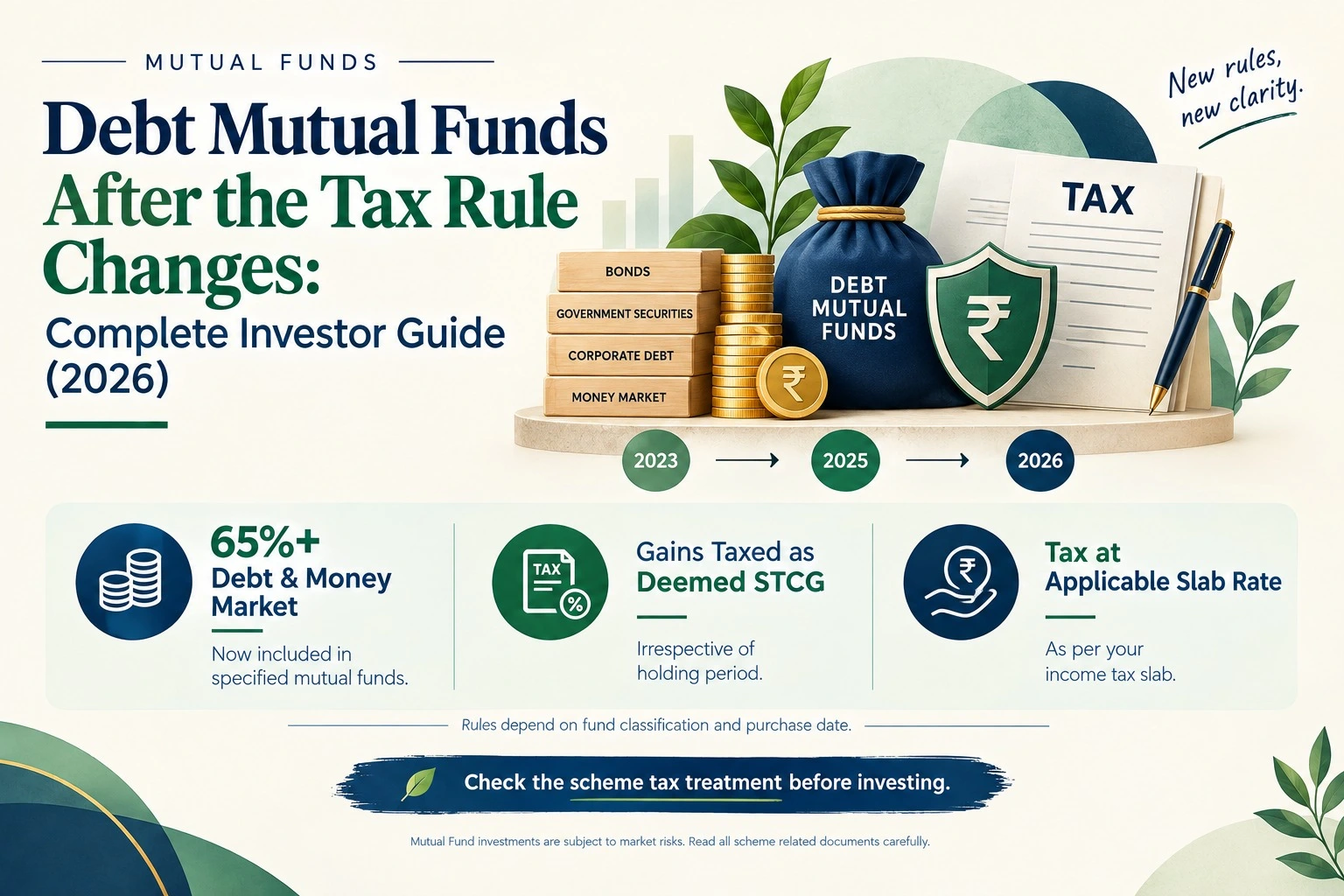
Debt Mutual Funds After the Tax Rule Changes: Complete Investor Guide (2026)
Debt Mutual Funds After the Tax Rule Changes: Everything Investors Need to Know (2026 Guide)
Debt mutual funds have long been a preferred investment option for conservative investors seeking stable returns, liquidity, and lower volatility than equity investments. They are commonly used for emergency funds, short- to medium-term financial goals, and portfolio diversification.
However, the taxation of debt mutual funds has undergone a major change in recent years. The removal of long-term capital gains (LTCG) tax benefits and indexation has significantly altered how these investments are taxed, making it essential for investors to reassess their strategies.
In this guide, we'll explain the latest debt mutual fund tax rules, how they affect different investors, and whether debt funds still deserve a place in your portfolio.
What Are Debt Mutual Funds?
Debt mutual funds invest primarily in fixed-income securities such as:
- Government Securities (G-Secs)
- Treasury Bills (T-Bills)
- Corporate Bonds
- Commercial Papers
- Certificates of Deposit
- Money Market Instruments
Unlike equity mutual funds, debt funds aim to generate relatively stable returns through interest income and capital appreciation from bonds.
While they generally experience lower volatility than equity funds, they are not completely risk-free. Returns depend on factors such as:
- Interest rate movements
- Credit quality of issuers
- Bond maturity
- Market liquidity
Types of Debt Mutual Funds
Debt funds come in various categories based on the maturity and quality of the securities they hold.
Liquid Funds
Suitable for parking surplus money for a few days to a few months.
Ideal for:
- Emergency funds
- Corporate treasury management
- Short-term surplus cash
Ultra Short Duration Funds
Invest in short-maturity debt instruments with relatively low interest-rate risk.
Ideal for:
- Investment horizon of 3–12 months
Short Duration Funds
Invest in bonds with moderate maturities, offering a balance between stability and returns.
Ideal for:
- Investment horizon of 1–3 years
Corporate Bond Funds
Primarily invest in high-rated corporate debt securities.
Suitable for:
- Investors seeking relatively stable returns with moderate risk.
Gilt Funds
Invest exclusively in Government Securities.
Although credit risk is minimal, these funds can be highly sensitive to interest-rate changes.
Dynamic Bond Funds
Fund managers actively change portfolio duration depending on interest-rate expectations.
Suitable for investors comfortable with moderate fluctuations.
How Were Debt Mutual Funds Taxed Earlier?
Until March 31, 2023 (for eligible investments), debt mutual funds enjoyed a significant tax advantage.
If held for less than 3 years
Capital gains were treated as Short-Term Capital Gains (STCG) and taxed according to the investor's income tax slab.
If held for more than 3 years
Capital gains qualified as Long-Term Capital Gains (LTCG) and were taxed at 20% with indexation benefits.
Indexation adjusted the purchase price for inflation, often reducing taxable gains substantially.
This made debt mutual funds more tax-efficient than many traditional fixed-income products.
What Changed?
The Finance Act, 2023 introduced one of the biggest tax reforms for debt mutual funds.
For investments made on or after April 1, 2023, debt mutual funds that invest 35% or less in equity no longer receive long-term capital gains treatment.
Instead:
- All capital gains are taxed according to the investor's applicable income tax slab.
- Holding period no longer provides a tax advantage.
- Indexation benefits have been removed for these investments.
This change applies regardless of whether you hold the investment for one year, three years, or even ten years.
Why Did the Government Change the Tax Rules?
The government introduced these changes to create greater parity between debt mutual funds and other fixed-income investments such as:
- Fixed Deposits
- Recurring Deposits
- Corporate Deposits
Previously, debt funds often generated better post-tax returns due to indexation benefits.
The revised rules simplify taxation while reducing differences between various fixed-income products.
How Do the New Rules Affect Investors?
1. Higher Post-Tax Liability
Investors in higher income-tax slabs may now pay more tax on debt mutual fund gains than under the previous system.
Without indexation, inflation no longer reduces taxable gains.
2. Holding Period Offers No Tax Advantage
Earlier, long-term investors benefited from lower effective taxation.
Now, whether you redeem after one year or five years, gains are generally taxed at your income tax slab (for applicable debt funds).
3. Greater Importance of Investment Goals
Debt mutual funds should now be selected based on:
- Liquidity
- Risk profile
- Portfolio diversification
- Interest-rate outlook
—not merely tax efficiency.
Are Debt Mutual Funds Still Worth Investing In?
Yes—but for different reasons than before.
Despite the tax changes, debt mutual funds continue to offer several advantages.
Professional Management
Experienced fund managers actively manage interest-rate risk, duration, and credit quality.
Better Liquidity
Most open-ended debt funds allow redemption on any business day, unlike many fixed deposits that may impose penalties for premature withdrawal.
Diversification
Debt funds invest across multiple issuers and instruments, reducing concentration risk.
Variety of Choices
Investors can choose funds suited to different investment horizons and risk profiles.
Debt Funds vs Fixed Deposits
| Feature | Debt Mutual Funds | Fixed Deposits |
|---|---|---|
| Returns | Market-linked | Fixed |
| Liquidity | High | Moderate |
| Taxation | Income tax slab (for applicable funds) | Interest taxed annually |
| Professional Management | Yes | No |
| Interest Rate Risk | Yes | No |
| Credit Risk | Depends on fund | Depends on bank |
Who Should Consider Debt Mutual Funds?
Debt mutual funds may still be suitable for:
- Conservative investors
- Emergency fund planning
- Short-term financial goals
- Portfolio diversification
- Investors seeking alternatives to savings accounts
However, they may no longer be the most tax-efficient option for long-term investments in higher tax brackets.
Alternatives Investors May Consider
Depending on your financial goals, alternatives include:
- Fixed Deposits (FDs)
- Public Provident Fund (PPF)
- Employees' Provident Fund (EPF)
- RBI Floating Rate Savings Bonds
- Government Securities
- Target Maturity Funds
- Hybrid Mutual Funds
- Equity Mutual Funds (for long-term wealth creation)
Each option has different tax implications, liquidity, and risk levels.
Tips for Investors After the Tax Changes
Focus on Investment Objectives
Choose debt funds for stability and liquidity—not solely for tax savings.
Diversify Across Asset Classes
Maintain a balanced allocation between:
- Equity
- Debt
- Gold
- International Investments (where appropriate)
Match the Fund to Your Time Horizon
- Less than 6 months → Liquid Funds
- 6–24 months → Ultra Short or Short Duration Funds
- Longer horizon → Consider equity or hybrid funds based on risk tolerance
Review Your Portfolio Periodically
Tax laws and market conditions evolve. Review your investments annually to ensure they remain aligned with your financial goals.
Common Mistakes to Avoid
- Choosing debt funds only because of past tax benefits.
- Ignoring interest-rate risk.
- Investing without considering investment horizon.
- Chasing higher yields from lower-quality bonds.
- Comparing debt funds only with fixed deposits.
Conclusion
The taxation of debt mutual funds has changed significantly, but these funds continue to play an important role in a well-diversified investment portfolio.
While the removal of indexation has reduced their tax advantage, debt funds still offer liquidity, professional management, diversification, and flexible investment options for short- and medium-term financial goals.
Rather than selecting investments solely based on taxation, investors should focus on their financial objectives, risk tolerance, and time horizon. A diversified portfolio that includes debt, equity, and other asset classes remains one of the most effective ways to build long-term wealth.
If you're unsure which debt fund is appropriate for your goals, consider consulting a qualified financial advisor who can help design a portfolio suited to your needs.
Frequently Asked Questions (FAQs)
1. How are debt mutual funds taxed now?
For most debt mutual funds purchased on or after April 1, 2023 (that invest up to 35% in equity), capital gains are taxed according to the investor's applicable income tax slab, regardless of the holding period.
2. Do debt mutual funds still offer indexation benefits?
No. Indexation benefits have been removed for applicable debt mutual funds purchased on or after April 1, 2023. Earlier investments may continue to follow the previous tax rules, subject to applicable grandfathering provisions.
3. Are debt mutual funds better than fixed deposits?
It depends on your investment objectives. Debt mutual funds generally offer better liquidity, professional management, and portfolio diversification, while fixed deposits provide predictable returns. The right choice depends on your risk appetite, tax situation, and investment horizon.
4. Should I still invest in debt mutual funds after the tax changes?
Yes, if your goal is capital preservation, liquidity, emergency funding, or portfolio diversification. However, evaluate them based on overall suitability rather than tax efficiency alone.